
The Case for Renaming Ourselves
Humanity’s self-designation as Homo sapiens—“wise man”—is a cruel irony: our arrogance toward nonhuman animals and the natural world marks us as Homo stultus, foolish man who knew better and acted anyway.
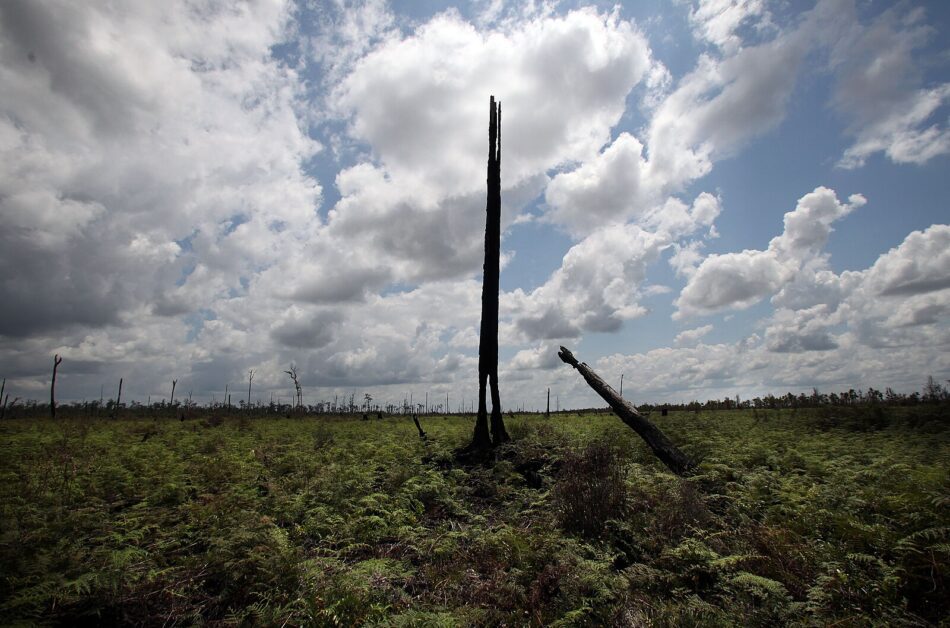
Kalimantan deforestation and degradation 4 – Wikipedia Commons
Summary: In this provocative essay, Martina Moneke argues that the scientific name Homo sapiens no longer reflects the reality of human behavior. Despite our intelligence, humanity has repeatedly demonstrated arrogance and ethical blindness—systematically misrepresenting the intelligence and agency of nonhuman animals while wreaking havoc on the planet. Drawing on philosophy, ecology, and recent scientific critique, including Christine Webb’s insights on the myth of human exceptionalism, she contends that our species’ greatest failing is believing we stand apart from the natural world rather than within it. Renaming ourselves Homo stultus (“foolish man”) would be a symbolic act of humility and a step toward genuine ethical evolution. Until we confront our folly, the epitaph of Homo sapiens will read: “He knew, and yet he did it anyway.”
Author: Martina Moneke
Author Bio: Martina Moneke writes about art, fashion, culture, and politics, drawing on history, philosophy, and science to illuminate ethics, civic responsibility, and the imagination. Her work has appeared in Common Dreams, Countercurrents, Eurasia Review, iEyeNews, LA Progressive, Pressenza, Raw Story, Sri Lanka Guardian, Truthdig, and Znetwork, among others. In 2022, she received the Los Angeles Press Club’s First Place Award for Election Editorials at the 65th Annual Southern California Journalism Awards. She is based in Los Angeles and New York.
Credit Line: This article is licensed by the author under the Creative Commons Attribution-NonCommercial-ShareAlike 4.0 International License (CC BY-NC-SA 4.0)
Date: December 8, 2025
The name Homo sapiens—Latin for “wise man”—has always carried an air of self-congratulation. Carl Linnaeus, the father of modern taxonomy, coined the term in 1758, confident that his species stood apart by virtue of intelligence and reason. But what if wisdom, properly defined as the capacity to act with foresight and moral restraint, has proven not to be humanity’s defining trait but its greatest delusion? In an era of mass extinction, climate collapse, and ecological disintegration—each driven by our own actions—perhaps it is time to set the record straight.
The species that burns its own home for temporary comfort, poisons its water for profit, and annihilates the other inhabitants of its shared planet for convenience should no longer be known as Homo sapiens. The more fitting name is Homo stultus—“foolish man.”
Our folly is not merely in error, but in pattern. Every major technological triumph has been followed by an ecological tragedy. The Industrial Revolution, heralded as the dawn of modernity, unleashed the carbon age that now suffocates our atmosphere. The Green Revolution, celebrated for ending hunger, saturated the planet’s soil and water with synthetic poisons. The Digital Revolution, promising connection and enlightenment, has given rise to surveillance capitalism and vast amounts of e-waste. We create miracles, but cannot master moderation.
Unlike the natural systems we disrupt, our civilization is not circular but linear: it extracts, exploits, exhausts, and discards. We treat the Earth as if it were a warehouse of infinite inventory, not a living organism with its own limits. The philosopher Hans Jonas warned in The Imperative of Responsibility (1979) that technological power had outpaced ethical maturity. He advocated for a moral framework that considers the long-term consequences of human actions on the planet’s future. Yet, four decades later, the counsel went unheeded. We continue to act as if tomorrow were someone else’s problem.
Wisdom implies learning from mistakes. But Homo stultus repeats them on a greater scale. Despite decades of scientific consensus on climate change, greenhouse gas emissions hit record highs in 2023. Despite global agreements to protect biodiversity, deforestation and species loss are accelerating. We congratulate ourselves on electric cars while expanding highways. We cheer reforestation projects while razing old-growth forests for palm oil and soy. We recycle plastic bottles, knowing that only a tiny fraction will be reborn.
Our ignorance is willful. It is not that we do not know, but that we prefer not to know. In the words of philosopher Günther Anders, humanity suffers from “apocalyptic blindness”—a refusal to comprehend the full extent of our destructive power. We are like Icarus, wings aflame, marveling at our altitude while plummeting toward the sea.
The root of our folly lies in the myth of human exceptionalism—the belief that we stand apart from and above the natural world. This myth is the theological residue of a species that once believed itself made in the image of a god. It gave rise to the notion of dominion: that Earth and all its creatures exist for our use. The Bible’s command to “subdue the Earth” became the philosophical foundation of extractive capitalism and colonial conquest.
But biology tells another story. We are not lords of creation, but products of evolution—kin to the chimpanzee, cousins to the coral, participants in the web of life we now unravel. As the primatologist Christine Webb argues in her 2025 book The Arrogant Ape, the supposed chasm between human and animal intelligence is “systematically rigged in our favor.” For centuries, researchers compared privileged, well-fed human subjects to captive animals deprived of social and environmental richness, using the results to claim our superiority. We design experiments that confirm what we wish to believe: that we are singular, elevated, unique. It is not proof of wisdom, but evidence of vanity.
Even this vanity is learned. Webb notes that children naturally assume agency and feeling in animals until they are “trained out of it.” Anthropocentrism, in other words, is a kind of education—a cultural conditioning that replaces empathy with hierarchy. We begin life sensing kinship and end up defending dominion. Homo stultus’ estrangement from the living world is not instinct but indoctrination, a symptom of modernity’s arrogance.
If the arrogance of Homo stultus has an epoch, it is the modern industrial age—the blink of evolutionary time that has transformed the Earth more drastically than any natural force since the last ice age. It was not evolution that taught us to view animals as machines, but philosophy: Aristotle’s “ladder of nature,” Descartes’s automata, the Enlightenment’s cold rationalism. As Val Plumwood argues in Feminism and the Mastery of Nature, the “master model” of humanity relies on “seeing the other as radically separate and inferior… whose agency is denied or minimized,” a denial that severs our ethical and existential connection to the living world. In other words, to destroy nature is to undermine ourselves. Homo stultushas yet to grasp that our survival is inseparable from the survival of the biosphere.
The Anthropocene—our self-proclaimed epoch—is both a monument and a tombstone. It commemorates our dominance and foretells our demise. In 2022, the Intergovernmental Panel on Climate Change warned that we are approaching multiple “irreversible tipping points”: the collapse of ice sheets, the die-off of coral reefs, the destabilization of forests. Each system we push past its threshold accelerates the collapse of others. The planetary fabric is tearing.
And yet, denial persists. Politicians still debate whether to act; corporations continue to profit from the delay. The pursuit of perpetual growth—an economic fantasy incompatible with a finite planet—remains sacred dogma. The environmental philosopher Timothy Morton calls this the “hyperobject” of modernity: a phenomenon so vast and entangled that we cannot fully perceive or escape it. Our predicament is that we have become too powerful for our wisdom and too foolish for our power.
To rename ourselves Homo stultus is not mere cynicism. It is an act of moral realism. Names shape identity, and identity shapes behavior. To be “wise man” is to assume that wisdom already defines us; to be “foolish man” is to recognize that it does not. Such recognition could mark the beginning of genuine wisdom—the kind born of humility rather than hubris. Imagine if every schoolchild learned that humanity’s scientific name meant “foolish man.” What might that do to our sense of destiny? It might instill a healthy shame—a reminder that intelligence without empathy is ruinous, and reason without restraint is madness. It might compel us to see that survival requires not domination but cooperation, not mastery but modesty.
Indigenous worldviews have long embodied this humility. The Lakota phrase Mitákuye Oyás’iŋ—“all my relations”—expresses a profound ecological kinship. The Māori speak of kaitiakitanga, the guardianship of the land and its resources. In these traditions, the Earth is not property but a relative, and every action carries consequences for the whole. In adopting such perspectives, Homo stultus might finally earn the right to reclaim the title sapiens.
There is tragic irony in our predicament: the same consciousness that enables us to perceive the beauty of a coral reef also allows us to destroy it. The same intelligence that sent us to the Moon cannot ensure clean water for all on Earth. We are capable of awe and atrocity in the same breath. The philosopher Albert Camus wrote that the only truly serious philosophical question is whether life is worth living. Today, the question extends to our species: are we worth preserving, given the damage we inflict on the living world?
Perhaps the answer depends on whether we can change—not technologically, but spiritually. The machines are not the problem; the mind behind them is. To confront our folly is to reclaim the moral dimension of intelligence. As Aldo Leopold wrote in his 1949 book A Sand County Almanac, “A thing is right when it tends to preserve the integrity, stability, and beauty of the biotic community. It is wrong when it tends otherwise.” By that measure, Homo stultus has been wrong for far too long. If wisdom means knowing what must not be done, then the wise course now is restraint: to stop before thresholds break, to let forests regrow, to let oceans heal, to let the air clear. But restraint requires imagination—the ability to see value beyond profit and time beyond the human lifespan.
Whether we can find that imagination, and whether Homo stultus can evolve again—not biologically but ethically—remains to be seen. Linnaeus could not have foreseen that the species he named would one day pose a threat to the planet itself. But if we summon the courage to look honestly at our reflection, there is still hope. To call ourselves Homo stultus is not to accept despair; it is to confront it. Only by admitting our foolishness can we aspire to wisdom. Until then, the epitaph of Homo sapiens should read: “He knew, and yet he did it anyway.”