
Sarah Paulson Lives for the Drama
By Jazmine Hughes From The Cut

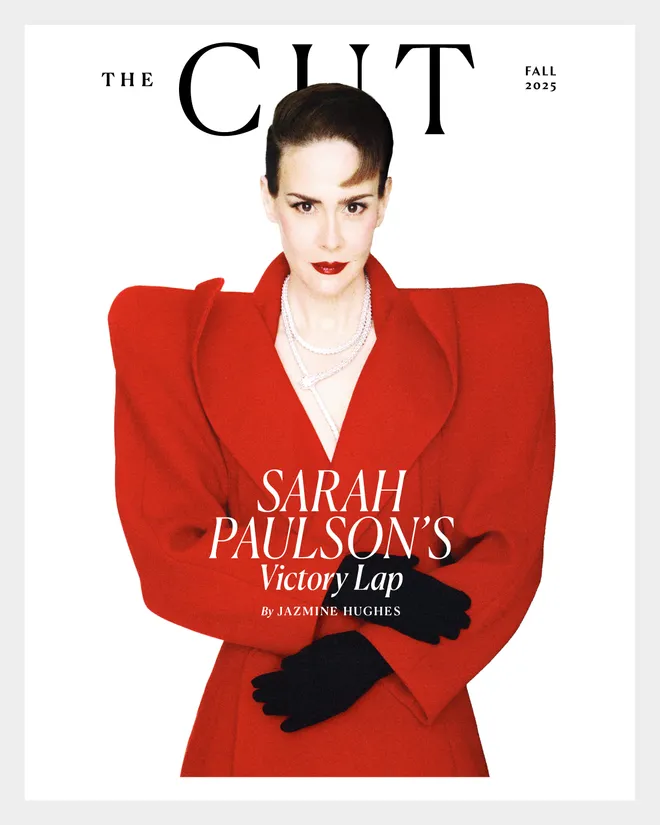
Sarah Paulson Lives for the Drama The actress lets us in on her enviable Hollywood life ahead of Ryan Murphy’s next juicy series, All’s Fair.
Sarah Paulson has been inside the Metropolitan Museum of Art many times — having attended five real Met Galas and one fake one while filming Ocean’s 8 — but today she is visiting simply as a civilian, a woman in search of art. “It’s funny to be here as a person just enjoying the museum,” she says on a particularly mobbed summer Friday afternoon. “You’re like, Oh, this is what it’s for.”
To describe Paulson is to pull out all the offbeat adjectives from the back of the drawer: She’s zany and ribald and outré, telling me about her Bart Simpson–esque burps and debating what we should call boobs (“I’m certainly not saying ‘breasts.’ I know someone who says ‘bosom,’ and that’s not my favorite thing, and she knows I don’t like to hear the word. And maybe that person is Holland Taylor”). When the ticket scanner makes a Martian-sounding zap as we enter the museum, she makes a zap sound right back. She had been eager to see the John Singer Sargent exhibition, in part because Taylor, an actress and Paulson’s partner of ten years, has told Paulson that she reminds her of Sargent’s best-known work, Madame X. A painting of an elegant 19th-century socialite in a black gown that contrasts starkly with her pearlescent skin, the portrait was considered shocking for the time. “It was something I wore or something, and she said, ‘Sometimes you look like a Sargent painting,’” Paulson recalls.
Paulson moves sylphlike and with an understated eroticism through the museum. She’s dressed in an oversize striped button-down shirt and white cotton pants by The Row, her face dewy (“I’m serving no-makeup realness”) since she has met me after a facial. She marvels at Sargent’s adroitness with light and shadow, his sensual renderings of texture and movement, and the sheer size of his canvases, exclaiming “I love it!” or “Gorgeous!” under her breath. “I wasn’t a museum person. Holland has absolutely changed something,” she says.
Her romance with Taylor has become as central to Paulson’s lore as her acting. The two delight fans with their titillating age gap (Taylor is 82 to Paulson’s 50), dream living situation (they’ve been together for a decade but keep separate houses), and unexpected origin story (Taylor slid into Paulson’s Twitter DMs). They are publicly effusive about each other in a way that feels genuine. One year, on Taylor’s birthday, Paulson wrote: “All roads lead me to this face, those eyes, that soul. You are, quite simply — everything to me.” And for Paulson’s birthday last year, Taylor posted: “Her generosity is legendary, like someone throwing money off the back of trains. But it is the depth of feeling in all her relationships … that is so moving to me. Sarah is a serious person. And I seriously love her.”
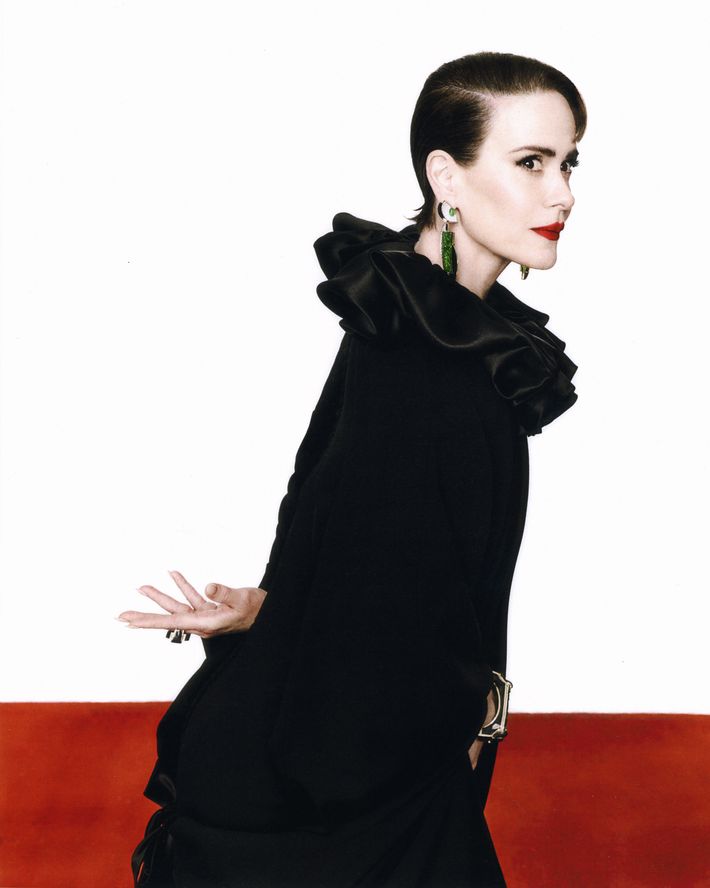
VIKTOR&ROLF HAUTE COUTUREBalloon-Shaped Dropped Volume Coat in Heavy Black Crêpe With Triple Tubular Hem, Silk-Satin Collar and Cuffs, Feather-Plucked Front, Fabric-Covered Buttons, and Satin Band and Bow, available upon request. DAVID WEBB Emerald Earrings, Carved Jade Bracelet, and Enamel Ring, at davidwebb.com.Photo: MAR+VIN
We stop in front of one of Sargent’s sketches of Virginie Amélie Avegno Gautreau, Madame X herself. Sargent drew her repeatedly in studies, obsessing over her profile: the long ski-slope nose, the petite jut of her chin, the length of her neck. Paulson points out the way the painter was drawn to people’s distinctive features. “It’s not necessarily about her being the most beautiful — she’s the most interesting,” Paulson says, gesturing toward the artwork. It’s a lesson worth internalizing. “When I get frustrated, if there is a part that I wanted that I didn’t get,” Paulson says, Taylor reminds her of her own artistic uniqueness with a simple phrase: “You’re not for all markets.”
But Paulson is precisely right for Ryan Murphy’s market, a perfect vessel for his many pulpy, melodramatic explorations of queerness, both strange and gay. In November, Paulson will star in All’s Fair, the newest Murphy vehicle for beautiful divas and the gay men who idolize them, alongside Kim Kardashian, Niecy Nash-Betts, Glenn Close, and Naomi Watts. The women — whose names sound like a mash-up of Dynasty characters and Monopolyproperties: Nash-Betts plays Emerald Greene; Kardashian is Allura Grant — work at a law firm run by Close’s character. (Famed divorce attorney Laura Wasser is a producer on the show.) Paulson plays Carrington Lane, the outsider of the group, who is excluded when her colleagues decide to open their own firm and dedicates her life to exacting revenge. “She’s made a career of challenging herself by taking on unsympathetic characters and turning them into heroines that you root for,” Murphy says.
At the Met, Paulson doesn’t have her glasses on, so I read her the blurbs accompanying the paintings. One sounds particularly familiar. An acquaintance of Sargent described some of his paintings as being a “good deal inspired by the desire of finding what no one else has sought here: unpicturesque subjects, absence of color, absence of sunlight.”
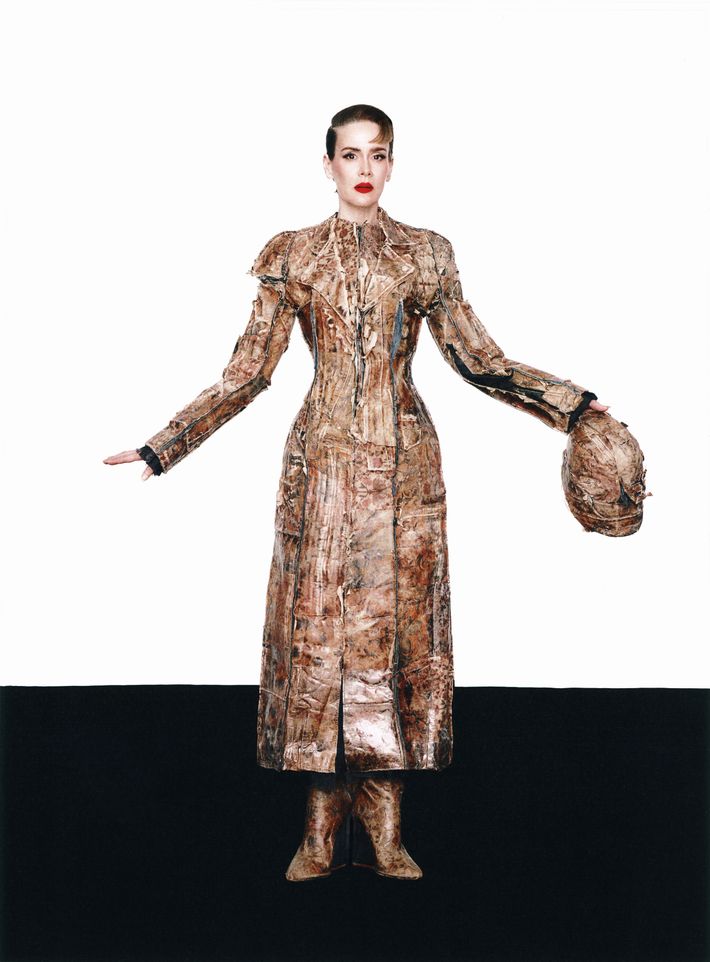
MAISON MARGIELA ARTISANAL COLLECTION Coat, Dress, Corset, Tabi Claw Boots, and Mask, available upon request.Photo: MAR+VIN
Paulson has worked with plenty of other auteurs — Steve McQueen, Todd Haynes, Aaron Sorkin — but most of what we associate her with comes from Murphy’s twisted mind. He calls their partnership the greatest collaboration of his career. Murphy is matched perhaps only by Tyler Perry in his ability to churn out delicious variations of lavish, heavy-handed pulp, all screaming and crying and elaborate wigs. And because Murphy is the king of stunt casting, he needs a center — someone indomitable like Paulson, who can excavate the most serious emotions but understands camp and humor, an actor who can hold any scene, no matter how outrageous. All’s Fair is one of about a dozen projects Paulson has worked on with Murphy since 2011; she has played conjoined twins, a drug-addicted ghost, a murderous gay journalist, and a torture-obsessed Nurse Ratched from a One Flew Over the Cuckoo’s Nest prequel. She has been nominated for nine Emmys for seven different Murphy shows. (She also appeared in season two of Murphy’s medical drama Nip/Tuck in 2004.) Paulson has the uncanny sensibilities of a true character actor, someone who can pick up on the tiniest notes and imbue a character with the idiosyncrasies that make them feel real. “Sarah never does anything in an obvious way,” Murphy says.
In The People v. O. J. Simpson: American Crime Story, she became Marcia Clark, the lead prosecutor on the case, by parroting the lawyer’s walk, with her feet slightly turned out, and the way she turned down her chin and led with her left hand. But her face is her best instrument: Paulson’s big brown eyes can make her look doelike or steely or completely vacant with equal ease. In a scene where Clark enters the courtroom after having her hair cut and faces the ridicule of the judge and male attorneys, an entire spectrum of emotion plays out on Paulson’s face: insecurity, shame, pride, defiance, conviction, gratitude. She brings the same commitment to her campier characters, like the spell-casting, potion-brewing, clairvoyant witch Cordelia Foxx of American Horror Story: Coven. The headmistress of an embattled supernatural all-girls academy in New Orleans, Foxx is blinded not once but twice in the season: first, in an acid attack perpetrated by a cloaked enemy (Paulson wrenches her character into a rictus of torment, her howls reverberating so dramatically they practically change octaves), and second, by her own hands, when the headmistress witch realizes that repairing her eyesight has come at the cost of her newfound magical ability to see into the beyond. Paulson, as Foxx, raises garden shears to her face with such tremulous, fearful determination — shivering before she plunges the knife into each eye, wailing — that you forgive how ridiculous the plotline actually is.
Paulson loves the repugnant, building a career from getting under the skin of grotesque characters to find the crumb of the thing she has in common with them, whether she’s playing an evil nurse or a sexy lawyer with a fuck-ass bob. “She always wants to have a hunchback and a snaggletooth and a crazy wig and stuff like that,” says her best friend, the actress Amanda Peet. “It’s a very American-actress thing to want to be likable and attractive while you’re trying to do the scene or tell the story, and I don’t think that interests her at all.” (“All I want is a peg leg and a black tooth in any role I play,” Paulson likes to say.)
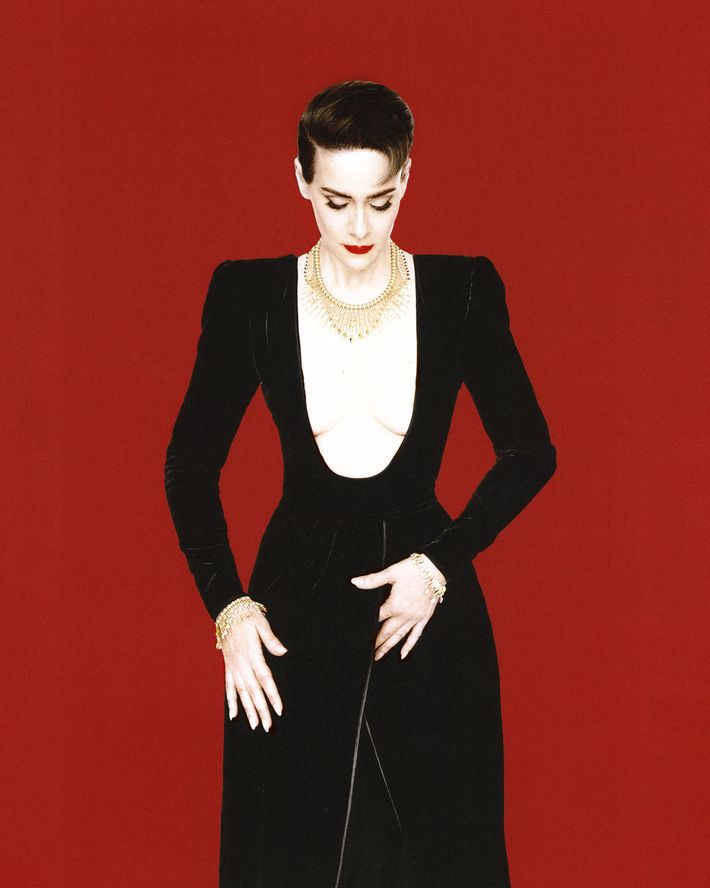
VALENTINO Dress, similar styles available at boutiques. TIFFANY & CO. Arrow Necklace, Arrow Bracelet, and Flames Bracelet From Blue Book 2024: Tiffany Céleste Collection, at tiffany.com. Photo: MAR+VIN
All’s Fair is one of Paulson’s few straightforwardly glamorous roles. With Kardashian’s involvement, the show took on a high-fashion bent, which gave Murphy and Paulson a distinct layer to apply to the character: Lane is all glamour on the outside (her character’s look took inspiration from Steven Meisel’s photographs of Linda Evangelista and Christy Turlington), but the chic sheen masks the character’s pain, both psychological and physical. Case in point: Murphy says he wanted to integrate gloves into Lane’s wardrobe. Paulson took that detail and blew it out, creating a backstory about how the character used to cut herself and needs gloves to hide the scars. “What happens is that she’ll tell me something like that and I go off and write it and rarely does she have a question because she likes the challenge of, Okay, it’s my job to interpret it,” says Murphy.
Glenn Close refers to Paulson as her North Star on the All’s Fair set. “She is acute to the point of being feral when she’s working — because she doesn’t miss a thing!” Close says. “She understands the tone. She understands the language.” After Close signed on to the project, the pair went to dinner and discussed Murphy’s style. “Sarah said, ‘You got to throw yourself in it, and it may seem scary and really over the top and baroque, but your job is to make it really real and then you will be completely liberated,’” Murphy tells me. That, in essence, is Paulson’s specialty. There are so many actors we admire for their subtlety and restraint, yet sometimes you just want dinner and a show — to put your disbelief up on a high shelf and forget about it for an hour. Her talent isn’t in just making the spectacle but in building a foundation strong enough to rest all the craziness on.
What Paulson loves about Murphy most, she tells me, is that he sees her differently from anyone else. “He has a unique X-ray vision where he can see inside your heart and he knows what to do with you,” she tells me over lunch at Sant Ambroeus Madison. No one else, she contends, would’ve cast her as Linda Tripp, the Clinton-administration employee who secretly recorded Monica Lewinsky discussing her affair with the president. With Impeachment: American Crime Story, released five years after the show’s first season, critics weren’t as enamored with Paulson’s Tripp as they were her Clark. “Even though it wasn’t as well received as I would have hoped, it was, for me, one of the artistic achievements of my life,” she says. “It’s kind of an amazing thing to have that be something that wasn’t even the most celebrated thing I’ve ever done because it’s more about my own personal assessment of what I felt about it, how I felt about doing it.” Otherwise, you risk becoming a disconnected, fame-addled actress, so wedded to the celebrity that you forget about the craft, she adds, pretending to sniff a line off her matcha.
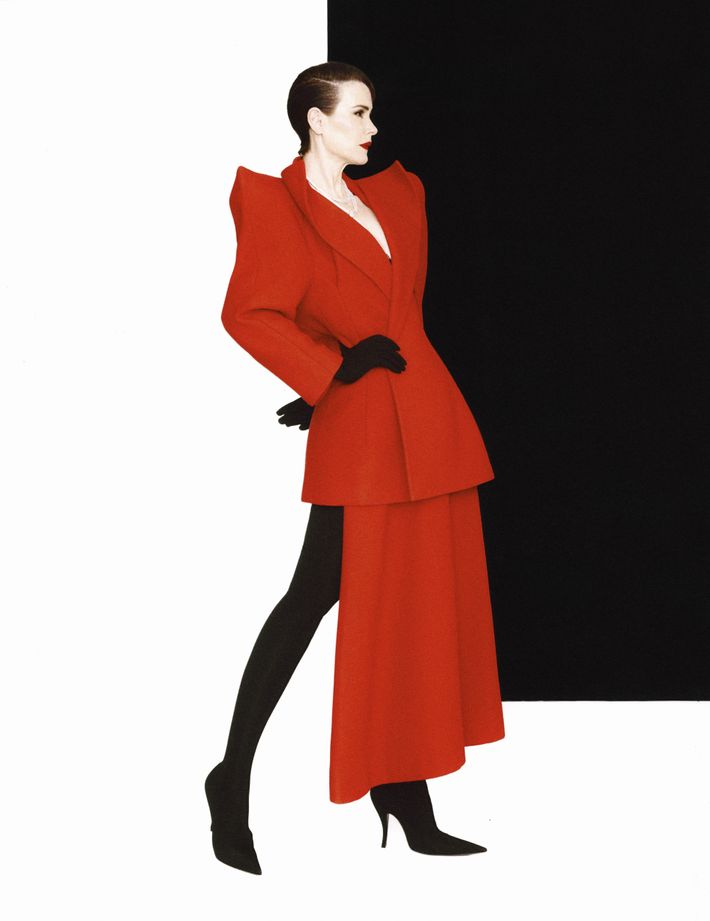
BALENCIAGA HAUTE COUTURE Open-Neck Jacket and Apron Skirt in Bright Red Wool, Wrist Gloves in Black Technical Jersey, and Concerto Pumps Pantashoes in Black Spandex Jersey, at couture.balenciaga.com. BVLGARI High Jewelry Serpenti Necklace, at bulgari.com. Photo: MAR+VIN
The flip side to Paulson’s attention to detail is, as she puts it, having an opinion on “fucking everything.” At lunch, she orders hamachi, ahi tuna, and a massive bowl of blueberries and cream. Sitting at the table next to us is a very well-put-together woman who has some hair out of place, sticking up on the back of her head. Paulson is distressed — why has no one told this elegant woman, who clearly takes great care in her presentation, the truth about how she looks? “That kind of thing makes me crazy, but also the nut bag of an actress in me is like, You’ve got to remember that,” she says. It could be a trait of a character who’s depressed, or who hasn’t gotten out of bed in a while, or someone who’s been sick, or someone who’s too consumed with something else to know how they look.
And when the woman-with-the-hair eventually comes over — they have a mutual friend, Randi Singer, the creator of 1999’s Jack & Jill — Paulson and I gang up to discreetly fix her hair without telling her. I ask to check the tag of her dress to see where it’s from, smoothing out as much of her hair as I can; Paulson, while hugging her good-bye, finishes the job. Jack & Jill was one of Paulson’s first big gigs, and even though it was canceled, she took home a souvenir: Peet was her co-star. “I have the kind of best friend that I would die without on the planet,” she says. She starts to list her other best friends: Carla Gallo, Leslie Grossman, Ella Beatty. “I don’t trust actresses who aren’t friends with other actresses. I think it says something gnarly about your soul.”
And Paulson is dedicated to making sure these friendships are not cannibalized by competition. “We’re both very dependent on each other,” says Peet. It was tricky for them when Paulson’s star rose, when Peet became the plus-one instead of Paulson, Peet recalls. “It’s probably part of the reason why we’re still here, because we didn’t get entrenched in certain roles and certain resentments. We surely had them, but we’re able to work through them,” Peet says. “She shares that need I have in relationships to totally go through it and talk about it and fucking go there and be really transparent. And it’s been really hard sometimes, but it’s also why we’re still incredibly close.”
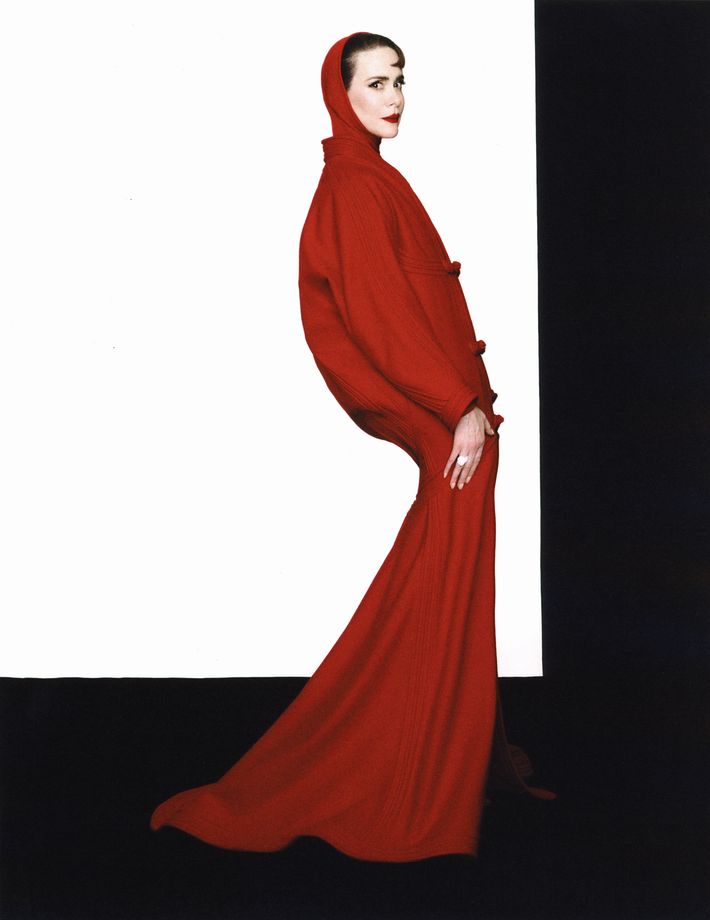
STANDING GROUNDRed Melton Wool Evening Coat With Encapsulated Bead Motif and Red Hooded Knit Evening Dress, available upon request. VAN CLEEF & ARPELSÀ Cheval Ring, at vancleefarpels.com.Photo: MAR+VIN
Though she now lives in Los Angeles, Paulson is a New Yorker, having moved to the city as a child after her parents divorced. Her father remained in Florida, but her mother, Catharine, wanted to be a writer. At 27, she moved herself and her two daughters to the place where she’d be able to do it. It’s a decision that Paulson remains both in awe of and indebted to. “It was my mother’s bravery and my mother’s pursuit of her creative life that made it possible for me to have the one I currently have,” she has said.
In 1993, Paulson graduated from La Guardia High School, where she thrived. She loved being surrounded by other artists who took themselves seriously, even if most of them were waiting for their wisdom teeth to grow in. “It was a very special environment to be around a bunch of kids who were wanting to dedicate their lives to this,” she says, scooping blue-berries into her mouth. After graduation, she continued to hang with her high-school crowd, a friend group that eventually expanded to include a young actor named Pedro Pascal, whom Paulson has saved in her phone as “My Man Pedro.” When she finds out he hasn’t yet given a quote for this story, “My Man” gets a voice memo: “Listen, I’m gonna cut you up into a million pieces. I remember talking a long, long time to the Vanity Fair writer for your cover, and I want to know why you’re not showing up for me. This is being recorded, so everyone in the world will know that you didn’t show up for me, and I just think the world should know who you really are,” Paulson joke-hisses into her phone.
“ It’s just the funniest thing,” Pascal says a few weeks later. “She’ll literally be that person who, like, texts and then, five minutes later, she’s like, ‘Hello?’ And you’re like, ‘Oh, really? You took about two weeks to answer my one question.’”
Out of their group of friends, Pascal says, Paulson was the first to start booking higher-profile gigs: an appearance on Law & Order or a role in an Off Broadway play. When things were really lean, Pascal has said, Paulson would give him her per diem money from set so he could afford food. “I, of course, wanted what was happening to her so badly, but we were still so unsurprised that it was happening,” he says. When their friends all got together to watch her Law & Order episode, they were impressed with the emotionality of her acting during an interrogation scene: “Like, Oh my God, she did it.”
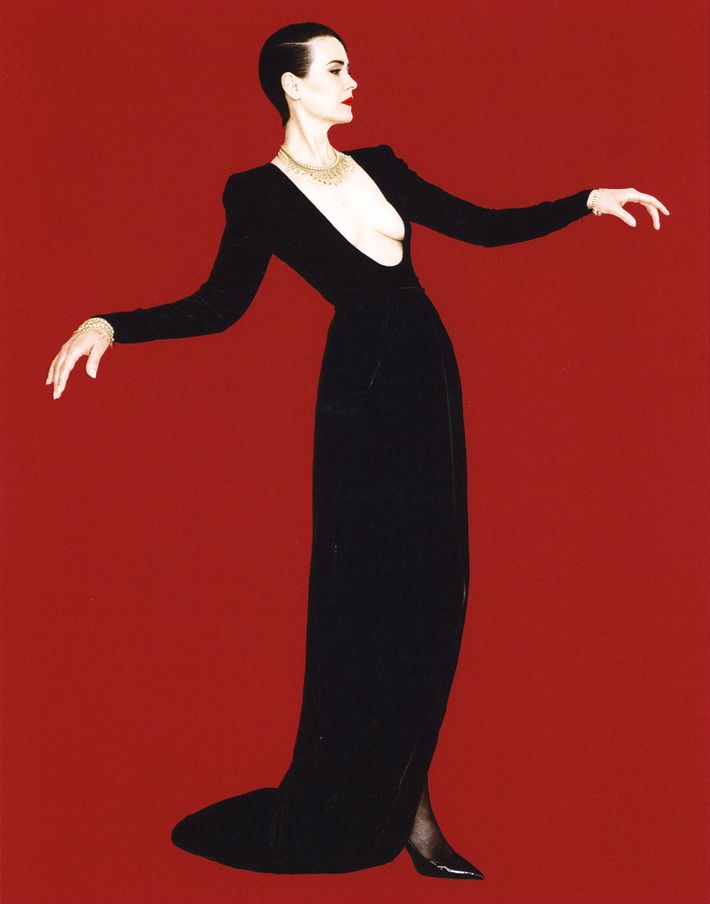
CHRISTIAN LOUBOUTIN Shoes, at christianlouboutin.com. WOLFORD Tights, at wolford.com. Photo: Charlie Gates
The two of them spent nearly two decades as working actors, a feat so difficult it’s second only to actually becoming famous. Neither saw their career take off in any big way until their late 30s. After Jack & Jill, Paulson’s next big project was Aaron Sorkin’s Studio 60 on the Sunset Strip, which was famously canceled after a single season. She had guest roles on Desperate Housewives, Grey’s Anatomy, and Law & Order: Special Victims Unit, but it wasn’t until 2011 that she gained real momentum. “All of a sudden, it started to feel like there was some velocity to something that there hadn’t been,” Paulson says. First came Martha Marcy May Marlene, an indie film that premiered at the Sundance Film Festival to much acclaim. Then came Game Change, where, as Nicolle Wallace, the senior adviser to John McCain’s presidential campaign, she had a memorable exchange with Julianne Moore–as–Sarah Palin about the Federal Reserve System. Remember in 2014 when we were all talking about how much Lupita Nyong’o deserved that Oscar for 12 Years a Slave? It was Paulson’s character, Mistress Epps, who inflicted that pain on Nyong’o’s character. Around the same time, Murphy cast Paulson in a leading role on the second season of American Horror Story, a series for which she’s earned five Emmy nominations for different characters over the years. She won an Emmy for The People v. O. J. Simpson and, last year, a Tony for her turn in Appropriate, the Branden Jacobs-Jenkins production where she plays a woman in denial about her father’s racist past.
“The things that have happened to me professionally — I could dream about them, but I could never actually imagine it in a tangible way,” she says. A psychic once told her she wouldn’t be famous until she was older; she was 37 and had been hustling for 18 years when Game Change came out. Both Paulson and Pascal are prime examples of how it’s much healthier to hit it big later in life: You’re committed to the art, not the attention; you build some sort of personal value system within yourself before everyone starts scrutinizing you. (Pascal was 39 when he got famous as Oberyn Martell on Game of Thrones.) Paulson is grounded and grown; she pursues life on her own terms. “She doesn’t have a white picket fence with the two kids. She’s been with men; she’s been with women. She’s not interested in being a spokesperson because she’s too busy being an actor,” Peet says. Also, when it comes to the job itself, she finds the fun while remaining conscious of how ephemeral it all is. “I wouldn’t say I’m glass half-empty, but I’m not half-full. I’m waiting for the other shoe to drop,” Paulson says.
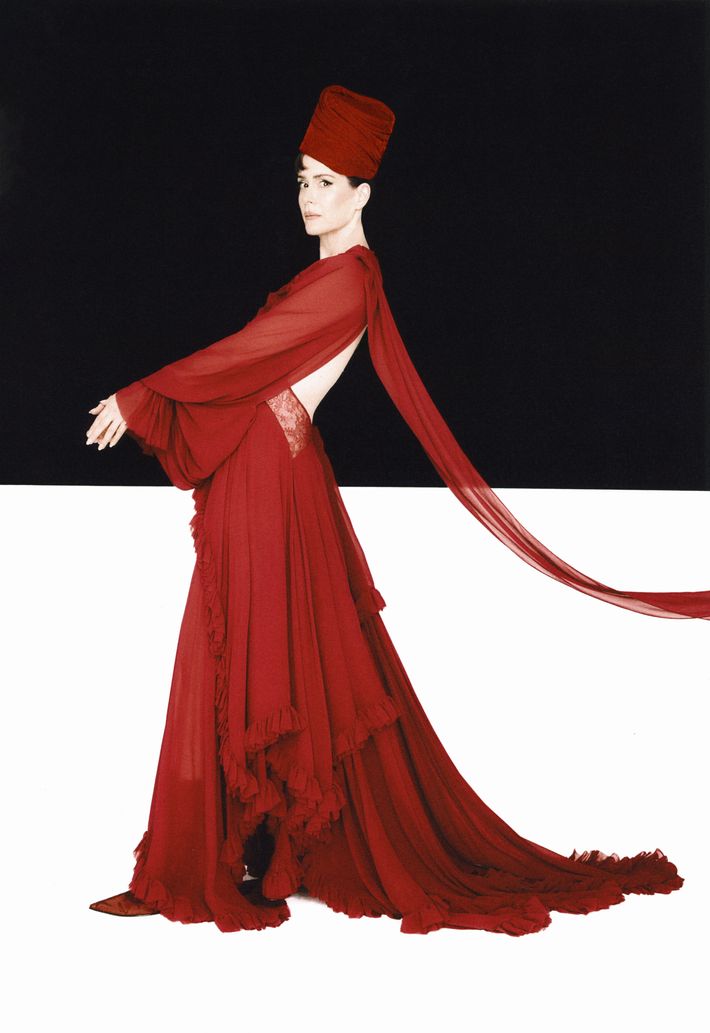
MCQUEEN Dress and Shoes, at alexandermcqueen.com. PIERS ATKINSON Hat, at piersatkinson.com.Photo: MAR+VIN
Her mother used to call her Sarah Bernhardt when she was younger, after the famed dramatic actress of 19th-century Paris, because of her penchant for, and comfort with, emotional extremes. (As a teenager, Paulson attempted to change the pronunciation of her name from Seh-rah to the more theatrical Sah-rah.) All during our lunch, she was fretting about a small catastrophe. Earlier that week, a baby dove had fallen from a tree into Taylor’s backyard, and Paulson’s dog Winnie had gone after it. She and Taylor were able to extract the bird from the dog’s clutches, and Paulson, anguished, drove the bird to a local wildlife center. She’d been anxiously awaiting updates — the mother bird remained in Taylor’s backyard, expecting her offspring’s return. Paulson was eager to make things right.
Peet tells me that Paulson’s devotion to animals borders on obsession; Paulson herself calls her dog-rearing a “psychosis.” (“Sometimes my mornings are just two hours of dealing with the dogs before I have sat down and had a sip of my tea, and Holland Taylor is like, ‘What is your problem?’” Paulson says.) So it was torturing Paulson that her beloved pet might be implicated in such suffering. A message from the wildlife sanctuary comes in, and Paulson reads aloud: “We make the best efforts to contact the finder for release. We cannot guarantee you’ll be contacted due to the overwhelming number of intakes … ” She trails off, distressed, then starts typing out her response: “I will die if you don’t let me know when the bird can be reunited with its mother, who lives in my backyard.”
A few minutes later, a representative for the center calls her, and Paulson sorrowfully recounts the week’s events: “Because when I came into the backyard, the mother was still there.” “I just couldn’t handle it; that’s just really hard to see.” “Let me know when the doctors are ready for that.” “Thank you so much. I really appreciate it. Bye-bye.” Then, like a geyser: “The dove died. The dove died. The dove died.” They put the bird in an incubator and oxygen chamber, but, the wildlife center said, the creature was too far gone. As we leave the restaurant, she FaceTimes Taylor, who doesn’t respond. Paulson goes directly into hypotheticals: What if the bird had fallen out of its nest and the dog hadn’t attacked it? What if the wildlife sanctuary was able to do more? She was stuck on how the mother bird was undoubtedly still waiting, hoping that her child would return to the nest. Paulson was trying to grasp that her baby was capable of the most unspeakable crime. “My perfect dog — the dog of my life — is always chasing birds, and I’m always like, What are you gonna do? ” She throws her hands up in the air, lamenting life’s agonies. “And then, guess what? The fucking dove died.”
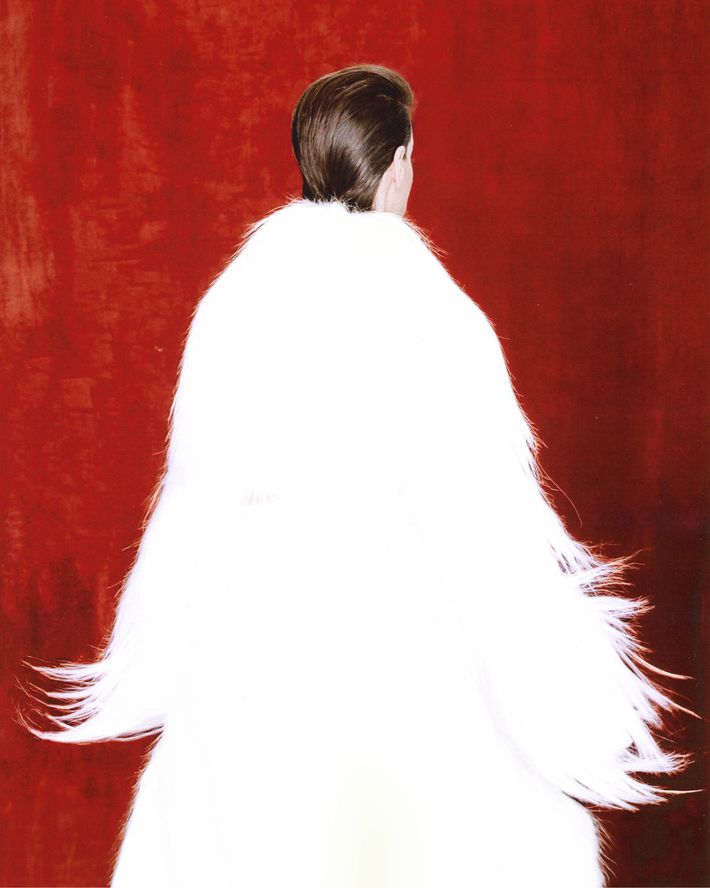
Photo: MAR+VIN
PRODUCTION CREDITS
- Photography by MAR+VIN
- Styling by Jessica Willis
- Digital Tech: Yoshi Park
- Photo Assistants: Javier Villegas and Karim Chehimi
- Styling Assistants: Oré Zacceah and Jack Novotny
- Hair: Hiro + Mari
- Makeup: Jezz Hill
- Manicure: Nori Yamanaka
- Set Design: Lane Vineyard
- Tailor: Lindsay Wright
- Production: Kindly Productions
- The Cut, Editor-in-Chief Lindsay Peoples
- The Cut, Photo Director Noelle Lacombe
- The Cut, Deputy Culture Editor Brooke Marine
- The Cut, Photo Editor Mara Rothman
- The Cut, Fashion Market Editor Emma Oleck
Want more son this story and many othertories like this one? Subscribe now to support our journalism and get unlimited access to our coverage. If you prefer to read in print, you can also find this article in the September 2, 2025, issue of New York Magazine.
For more on this story