
From Tehran to the World: What an Iran War Reveals About Global Fragility
Summary: Martina Moneke examines how a war with Iran could ripple far beyond the Middle East, testing the resilience of global systems and institutions. From regional proxy conflicts to disruptions in energy markets, financial networks, and political alliances, it traces the cascading consequences of a single flashpoint. Drawing on history, literature, and political theory, she shows how escalation rarely emerges from a single cause and how decisions, miscalculations, and structural vulnerabilities interact over decades and centuries. By envisioning the worst, Moneke highlights the responsibility embedded in the present moment and the possibility that restraint—or imagination—can alter the course of catastrophe.
Author: Martina Moneke
Author Bio: Martina Moneke writes about art, fashion, culture, and politics, drawing on history, philosophy, and science to illuminate ethics, civic responsibility, and the imagination. Her work has appeared in Common Dreams, Countercurrents, Eurasia Review, iEyeNews, Kosmos Journal, LA Progressive, Pressenza, Raw Story, Sri Lanka Guardian, Truthdig, and Znetwork, among others. In 2022, she received the Los Angeles Press Club’s First Place Award for Election Editorials at the 65th Annual Southern California Journalism Awards. She is based in Los Angeles and New York. Follow her on Substack.
Credit Line: This article is licensed by the author under the Creative Commons Attribution-NonCommercial-ShareAlike 4.0 International License (CC BY-NC-SA 4.0)
Date: March 10, 2026
KEY: catastrophic conflict modeling, diplomacy and restraint, financial market volatility, Gulf energy markets, humanitarian crisis, Iran–Iraq War history, Iran war scenario, international security, Middle East conflict, military escalation consequences, political fragility, regional proxy warfare, strategic waterways, Strait of Hormuz oil disruption, Tehran global instability, US-Iran relations
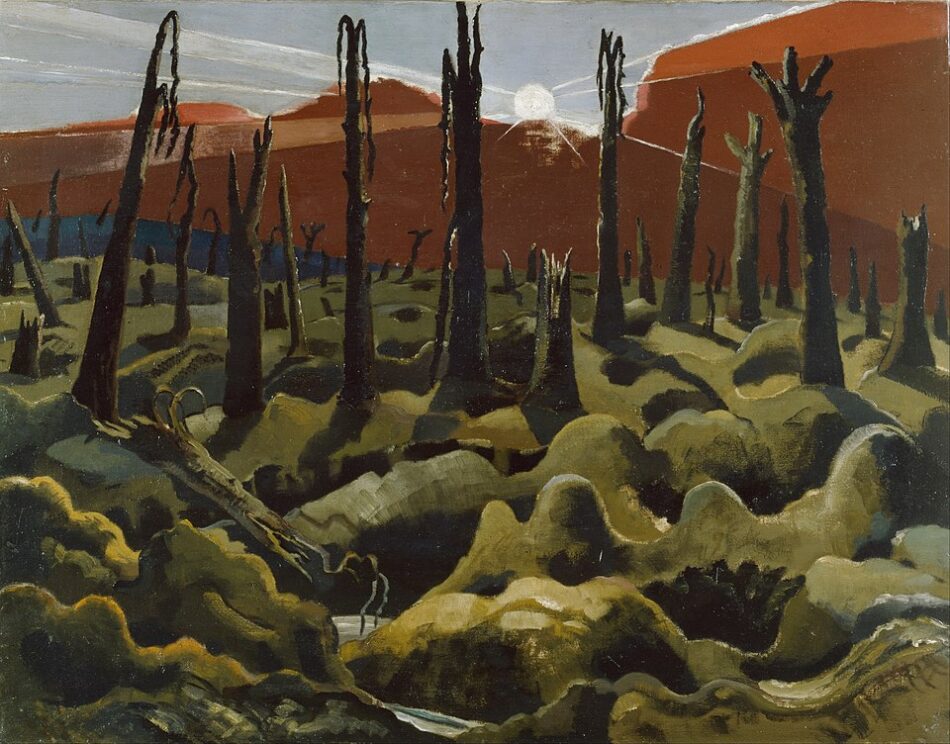
IMAGE: Nash, Paul – We are Making a New World -Wikipedia
A war with Iran could ripple far beyond the Middle East, testing energy systems, global markets, alliances, and human resilience. From immediate strikes to decades-long political, economic, and social transformations, the conflict exposes the fragility of international order and the stakes of decisions made under pressure, revealing how closely the fates of nations—and people—are intertwined.
The idea of war carries a strange rhythm. For long stretches, it moves slowly, almost invisibly, as tensions accumulate beneath the surface of ordinary life. Then, at moments that appear sudden and inexplicable, the rhythm accelerates, and the world convulses. In the contemporary age—where geopolitics, energy systems, and nuclear technologies interlock in uneasy proximity—envisioning a worst-case scenario involving Iran is not simply an exercise in speculation; it is a way of probing the fragility of the global order itself. To imagine catastrophe is to examine the structures that might enable it.
The Middle East has long stood at the center of modern geopolitical tension, a region shaped by the collapse of empires, the rise of new nation-states, and the enduring consequences of colonial borders drawn with little regard for cultural realities. The 20th century saw cycles of war that repeatedly defied lasting peace. The Iran–Iraq War of the 1980s devastated both countries and demonstrated how prolonged modern conflict could grind down societies without producing a clear resolution. The Gulf War of 1991 reshaped the balance of power in the region, while the 2003 U.S. invasion of Iraq destabilized political structures whose consequences are still unfolding today.
Iran emerged from this landscape as both a regional power and a political paradox—simultaneously constrained by sanctions and empowered through a network of alliances and proxy relationships stretching across Lebanon, Syria, Iraq, and Yemen. For Israel, Iran’s ambitions have long been interpreted through the lens of existential threat. For the United States, decades of involvement in the Middle East have produced a complicated mixture of strategic entanglement and domestic exhaustion. The relationship between these actors exists in a permanent state of tension: not open war, but rarely genuine peace.
To imagine a worst-case war scenario today requires stepping back into history. In 1914, the assassination of Archduke Franz Ferdinand—an act of violence carried out by one man against another—ignited a global war that reshaped the 20th century. The event itself was small in scale, yet it occurred within a volatile system of alliances, militarization, and nationalist anxieties already poised for eruption. The true lesson of that moment lies not in the assassination alone but in the fragile architecture it exposed. A continent that appeared stable collapsed almost instantly into catastrophe.
The parallel in the modern era is unsettling. When political systems concentrate power in the hands of a single leader—particularly when that leader operates with limited institutional restraint—the potential for impulsive decisions increases dramatically. In such circumstances, a rhetorical flourish, a strategic gamble, or even a momentary whim can reverberate through a global system already under strain. History and political theory suggest that when volatile structural conditions intersect with individual agency, the consequences can be wildly disproportionate to the initial act.
World War I did not end the cycle. Two decades later, unresolved grievances, economic collapse, and rising authoritarianism produced World War II, a conflict that dwarfed the first in scale and devastation. Entire cities were destroyed through aerial bombardment, civilian populations became deliberate targets, and the war concluded with the detonation of nuclear weapons over Hiroshima and Nagasaki. The resulting trauma reshaped the international system. Institutions such as the United Nations were established to prevent future wars, while treaties such as the Nuclear Non-Proliferation Treaty sought to restrain the spread of the most destructive technologies ever created. These frameworks represented an attempt to build guardrails around the impulses of power. The United Nations Charter articulated principles against aggressive war, while the Geneva Conventions codified protections for civilians and prisoners. Yet the decades since their adoption have demonstrated a persistent tension between aspiration and enforcement. International law relies on political will, which often falters in the face of national interest.
Against this backdrop, a military confrontation with Iran would unfold within a dense web of historical precedent, strategic rivalry, and fragile norms. The immediate consequences might resemble familiar patterns: targeted strikes, retaliatory missile attacks, and the mobilization of regional proxy groups. Civilian populations in Iraq and Syria could once again find themselves caught in overlapping conflicts. Yemen, already suffering one of the worst humanitarian crises in the world, might experience further devastation. Yet the conflict would almost certainly not remain regional for long. One of the most immediate global consequences would involve energy markets. Iran occupies a strategically critical position along the Strait of Hormuz, a narrow waterway through which a significant portion of the world’s oil supply passes. Even a temporary disruption—whether through naval confrontation, mining operations, or attacks on tankers—could send shockwaves through global energy markets.
The modern global economy remains deeply dependent on stable energy flows. Sudden price spikes ripple through supply chains with remarkable speed, affecting transportation, agriculture, manufacturing, and food production. The oil shocks of the 1970s showed how swiftly energy scarcity can trigger inflation, economic stagnation, and political unrest. A prolonged disruption in the Strait of Hormuz could generate similar dynamics on a global scale. For countries already struggling with economic instability, rising energy prices would intensify existing vulnerabilities. Import-dependent nations might face severe inflation, while governments confronted with public anger could experience political upheaval. Financial markets, hypersensitive to uncertainty, would amplify these disruptions, turning localized conflict into global economic turbulence. In this sense, a regional war becomes something larger—a stress test for the interconnected systems that sustain modern life. Trade networks, financial institutions, and political alliances all depend on a certain degree of stability. When that stability fractures, consequences propagate far beyond the initial point of conflict.
The strategic dimensions of such a war would be equally complex. Iran’s military capabilities, including ballistic missile systems and asymmetric naval strategies, are designed to complicate conventional warfare. Proxy networks across the region could transform a bilateral confrontation into a multi-front conflict stretching from Lebanon to the Persian Gulf. Israel, already engaged in persistent security challenges, would face heightened pressure to respond decisively to perceived threats.
Global powers would inevitably become entangled. Russia and China, both pursuing strategic influence across the Middle East, might exploit the situation to expand their geopolitical leverage. Meanwhile, the United States—already navigating domestic political divisions—could find itself pulled deeper into a prolonged conflict with uncertain objectives.
The medium-term consequences of such escalation could extend far beyond the battlefield. Wars often produce unexpected political realignments. Alliances that appear stable in times of peace may fracture under the pressure of prolonged conflict, while new partnerships emerge among states seeking stability or advantage. The international system has repeatedly demonstrated this capacity for rapid transformation.
Beyond geopolitics lies the human dimension of war, a dimension that literature and philosophy have long attempted to capture. The Greek historian Thucydides described the Peloponnesian War as a tragedy born from fear, honor, and self-interest. His analysis remains startlingly relevant in the modern era. War, he suggested, emerges not only from rational calculation but from the deeper impulses of human societies. The Prussian military theorist Carl von Clausewitz famously described war as the continuation of politics by other means, yet he also warned that once unleashed, war acquires a momentum of its own. Miscalculations accumulate. Plans collapse. What begins as a controlled exercise of force can quickly expand into something far more destructive.
Philosophers and writers have wrestled with this dynamic for generations. Hannah Arendt explored how systems of ideology can obscure individual responsibility, allowing ordinary people to participate in extraordinary violence. Wilfred Owen’s poetry from the trenches of World War I captured the brutal intimacy of modern warfare, while T. S. Eliot’s The Waste Land reflected a civilization spiritually disoriented by mass conflict. Other writers examined the bureaucratic and psychological absurdities of modern war. Joseph Heller’s Catch-22 revealed how military institutions can entrap individuals within an impossible logic, while Joe Haldeman’s The Forever War imagined conflict spanning generations, with its participants unable to return to the societies they once knew. George Orwell’s 1984 offered a darker vision still: a world in which perpetual war sustains systems of power, reshaping truth and perception themselves. These works remind us that war is not merely a geopolitical event but a cultural and psychological rupture. Societies emerging from conflict often carry invisible scars for decades. Memory becomes a landscape of mourning and myth, shaping national identity and political behavior long after the guns fall silent.
The economic consequences of a major regional war would unfold over similar timescales. Infrastructure destroyed in conflict takes years to rebuild. Investment shifts toward defense spending, diverting resources from social development. Inequality widens as vulnerable populations bear the heaviest burdens of disruption. Over decades, such effects accumulate into structural change. Entire generations may grow up in environments shaped by instability, migration, and scarcity. Cultural narratives adapt accordingly, reflecting both resilience and trauma.
Looking further into the future—half a century or more—the consequences of catastrophic conflict could reshape the institutions that govern global affairs. Previous world wars forced humanity to construct new frameworks for cooperation and restraint. The League of Nations emerged from the devastation of World War I, and the United Nations from the ruins of World War II. Each represented an attempt to prevent the recurrence of global catastrophe. Whether such institutions succeed depends on their ability to address underlying tensions rather than merely containing them. History suggests that political structures built after war are only as strong as the collective commitment to maintain them.
From a century-scale perspective, the possibility of war intersects with broader discussions of global catastrophic risk. Nuclear proliferation, environmental degradation, pandemics, and technological instability all interact within an increasingly interconnected world. None of these threats exists in isolation; they reinforce one another, forming a dense network of vulnerability. In such conditions, a regional war involving Iran could accelerate processes of instability already underway. Strategic waterways, nuclear technologies, and global supply chains converge in ways that amplify systemic strain. What begins as a localized confrontation could quickly become part of a much larger transformation in the global order.
Responding to this possibility requires more than military planning. It demands ethical reflection and leadership capable of anticipating extreme scenarios. The legal frameworks established after World War II represented an attempt—however imperfect—to restrain humanity’s capacity for organized violence. Strengthening those frameworks remains one of the few viable strategies for preventing catastrophic escalation. Seen through the lenses of history, philosophy, literature, and cultural memory, the politics of modern America and the wider world cannot be separated from the health of the planetary system that sustains them. Political decisions reverberate through economies, ecosystems, and societies with consequences that unfold over decades and centuries. The assumption that war is inevitable has often been used to justify preparations that make it more likely. Yet history also offers counterexamples: moments when diplomacy, restraint, and foresight interrupted cycles of escalation. Peace is not simply the absence of conflict but the deliberate management of tension.
Considering the worst-case scenario for a war with Iran is therefore not an exercise in pessimism. It is a form of diagnosis. By tracing the fault lines that run through the present moment, such analysis reveals how small decisions intersect with volatile structural conditions.
History offers no guarantees that catastrophe can be avoided. It does, however, illuminate the pathways through which catastrophe has occurred before. To contemplate the worst is also to recognize the responsibility embedded in the present moment. Escalation rarely emerges from a single cause; it develops through a chain of decisions, fears, ambitions, and miscalculations. Each link in that chain represents a point at which another choice might have been possible. Whether the world moves toward deeper fragmentation or renewed cooperation will depend on how those choices are made—and how quickly societies recognize the stakes. History’s rhythms are not inevitable. They emerge from decisions, the accumulation of tension, and moments when restraint—or even imagination—can interrupt the momentum toward catastrophe.