CCMI & Little Cayman Research Centre’s Science in Focus
SCIENCE SPOTLIGHT: AUGUST 2025

Cutting-edge scientific research is at the core of everything we do here at CCMI.
So far this year, this has included the conclusion of mapping offshore seamounts in the Cayman Islands and development of a chapter for the Cayman Islands Biodiversity Action Plan, resilience-based coral restoration, and an exciting discovery in CCMI’s Blue Carbon Offset and Biodiversity project which could shed light on impactful climate-change mitigation strategies in small island states!
‘For coral reefs worldwide, Little Cayman offers both a sobering warning and genuine hope… As ocean temperatures continue rising, the lessons from Little Cayman become increasingly vital. The path forward requires combining global climate action with local conservation excellence.’ – SevenSeas Media
CONTENTS
In this newsletter, we cover:
- Expedition Hope
- Coral Restoration
- CCMI X Butterfield: Blue Carbon Offset & Biodiversity
- Good Vibrations
- Healthy Reefs
- Upcoming Courses
- Recent Publications
EXPEDITION HOPE: MAPPING CAYMAN’S SEAMOUNTS
In March 2025, CCMI’s researchers completed a three-year project, funded by the UK Government’s Darwin Plus Programme, to explore and map previously uncharted seamounts in Cayman’s offshore marine area.
Through Expedition Hope, CCMI has successfully increased the evidence-base of seamount communities in the Cayman Islands. An ecological baseline has been established through scientific exploration which will be essential for future management and the project demonstrated an efficient and successful methodology protocol for seamount exploration that can be applied globally.
Expedition Hope has not only confirmed the presence of, but has also mapped in detail, the high levels of biodiversity on 12-Mile Bank and Pickle Bank seamounts. This information has been developed into a seamounts chapter for the Cayman Islands Biodiversity Action Plan.
In addition to informing policy, the project has engaged with a wide range of stakeholders in the Cayman Islands and internationally and disseminated findings to key audiences. Now, stakeholders have a better understanding of the biodiversity on these seamounts, their conservation requirements and why these ecosystems are vital to the health of the marine environment in the Cayman Islands and the communities that rely upon them.
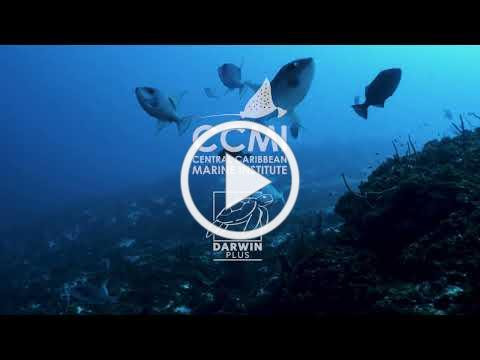
You can read more about this project in the mini-documentary below, on ourwebsite, watch this recent Reefs Go Live episode, or watch this 3-part docuseries.
CORAL RESTORATION
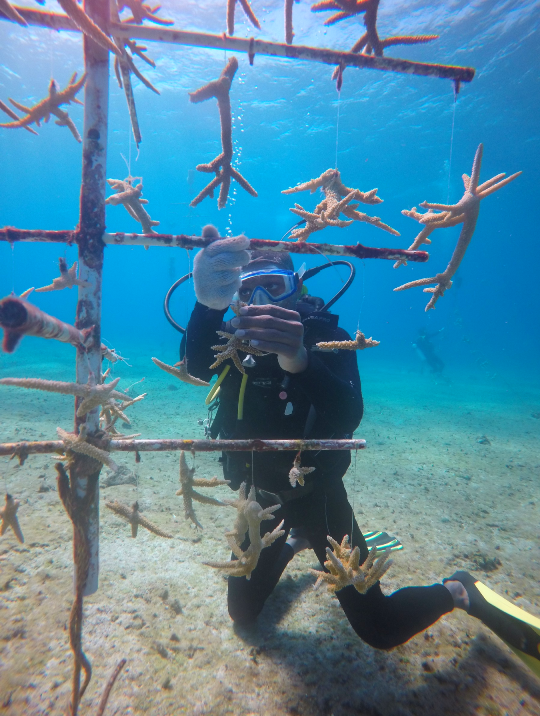
In a project funded by the UK Government’s Darwin+ Programme, The Ernest Kleinwort Charitable Trust, and the AALL Foundation, our researchers have been working to help our coral nursery to recover from the 2023 extreme marine heatwave.
At the end of the heatwave, the nursery was down to just 17 coral colonies that had survived. Now, the nursery is home to nearly 120 colonies, all of which are the highly thermally tolerant genotypes that survived the heatwave – and they have also survived a recent coral disease outbreak are now growing at a rate of just under 1 cm per week!
Read more about CCMI’s restoration programme
CCMI at the Association of Marine Laboratories of the Caribbean, Puerto Rico
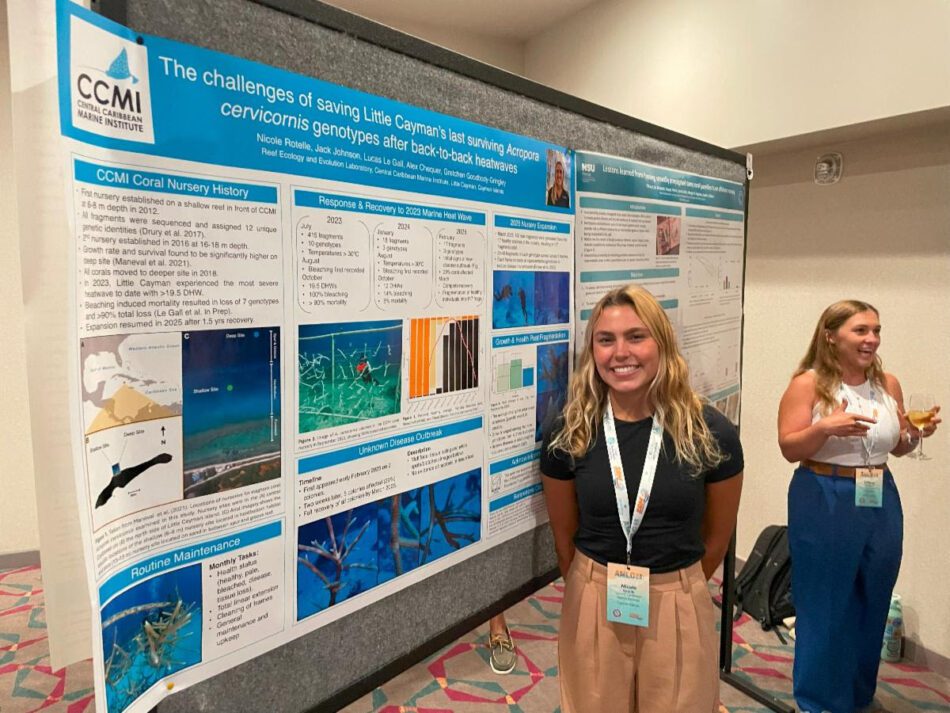
CCMI’s Director of Research, Dr Gretchen Goodbody-Gringley, recently hosted the 43rd Scientific Meeting of the Association of Marine Laboratories of the Caribbean in Puerto Rico, where the CCMI research team presented a number of ongoing project results.
Research Technician, Nicole Rotelle, presented a poster highlighting CCMI’s ongoing work on the challenges of protecting Little Cayman’s last surviving Acropora cervicornis(staghorn coral) genotypes following back-to-back heatwaves.
BLUE CARBON OFFSET AND BIODIVERSITY
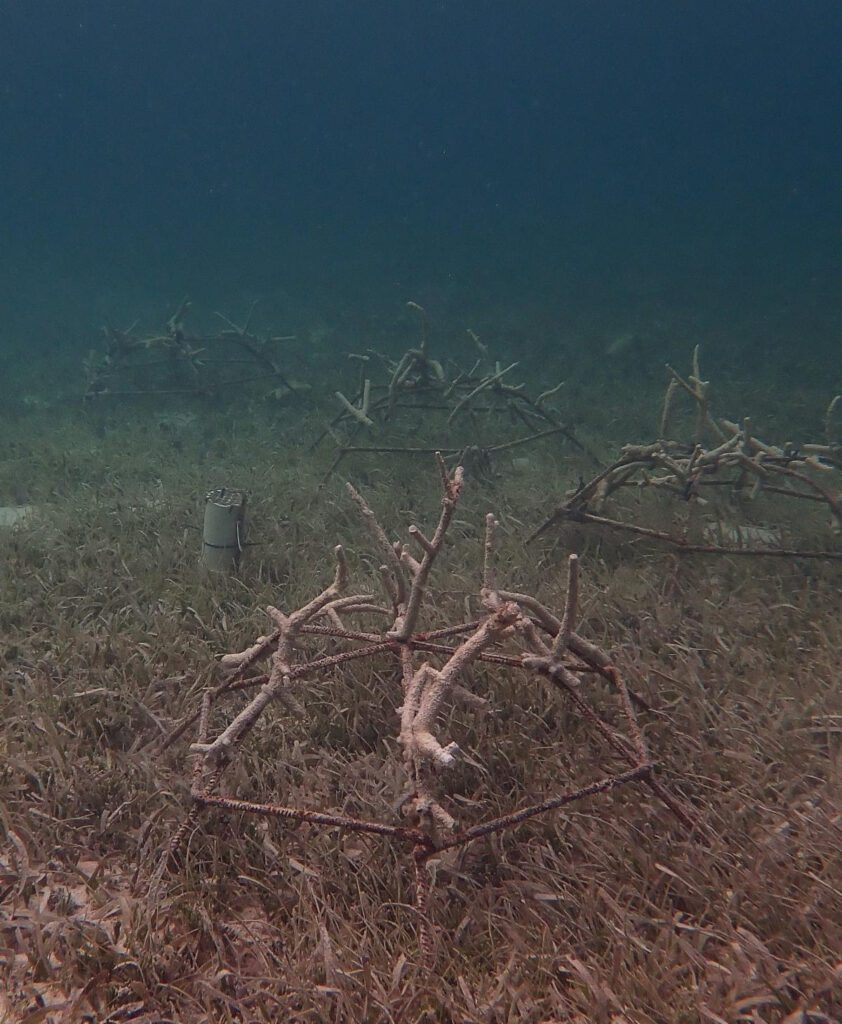
CCMI’s Blue Carbon Offset and Biodiversity project, made possible by Butterfield, aims to investigate key knowledge gaps to enable evidence-based investment in marine habitat restoration and blue carbon offset in the Cayman Islands and regionally.
This year, this has involved analysing the current level of carbon stored in Little Cayman’s seagrass meadows, which was completed in collaboration with Florida International University, and using sediment traps and tilt meters to monitor the levels of sediment stored by these seagrass meadows.
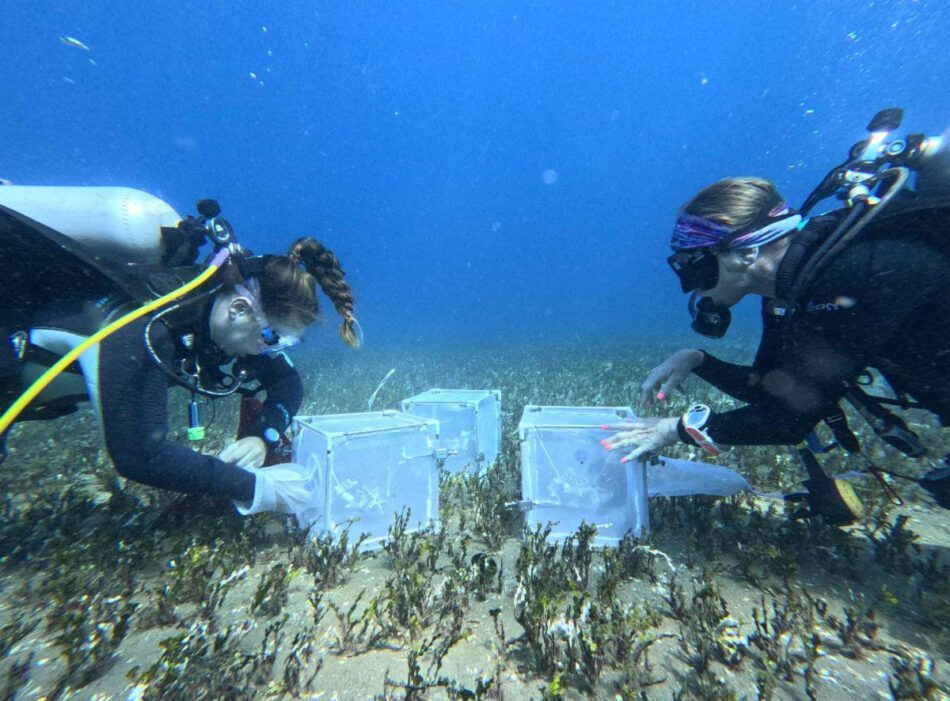
After analysis, the sediment traps and tilt meters were de-deployed alongside mock coral outplanting domes, to investigate the impact of coral restoration around seagrass meadows on sediment accumulation.
Excitingly, preliminary data analysis indicates that there is an increase in sediment accumulation associated with outplanting corals in and around seagrass meadows. This means that coral restoration near seagrass meadows may have a positive effect on the amount of carbon that seagrass can sequester from the environment, potentially helping to mitigate climate change impacts.
Read more about this project on our website and watch this space for further updates from this exciting project!
GOOD VIBRATIONS
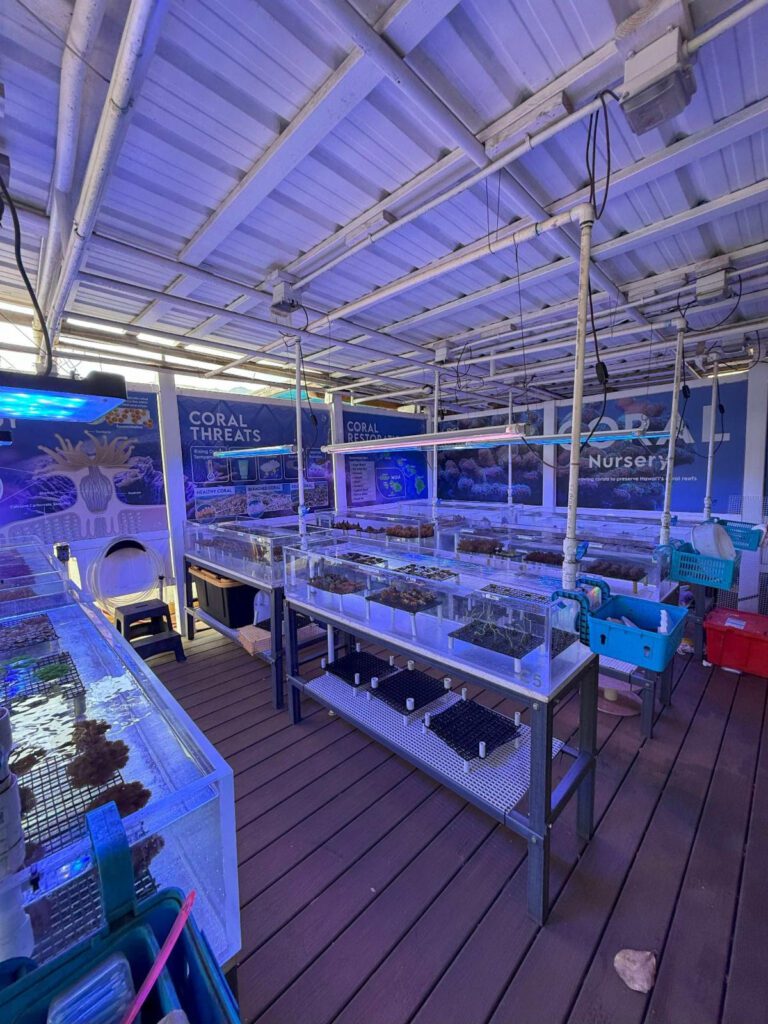
CCMI’s research team has recently returned from Maui, where they were working with Woods Hole Oceanographic Institute (WHOI) on the CORDAP-funded project, Good Vibrations.
The project focusses on using acoustic enrichment to boost coral larvae settlement. The sounds of a healthy coral reef played back underwater encourage coral larvae to settle and have the power to rebuild local reefs.
While in Maui, the team monitored two Pacific coral species Monitpora capitata and Pocillopora damicornis (PDAM) for spawning. After a very successful PDAM spawn, they spent many days in the lab collecting and counting larvae and, in the field, deploying reef acoustic playback systems, positioning sound traps and running experiments.
The researchers placed larvae in cups and tents and deployed them at our experimental and control sites for sound-based settlement experiments. After two days we recovered the cups and tents and took them back to the lab to score them for settlement. The results are still being analysed but watch this space for updates from this exciting project!

HEALTHY REEFS
Read the 2024 Report Card
Healthy Reefs Report Card(2024)
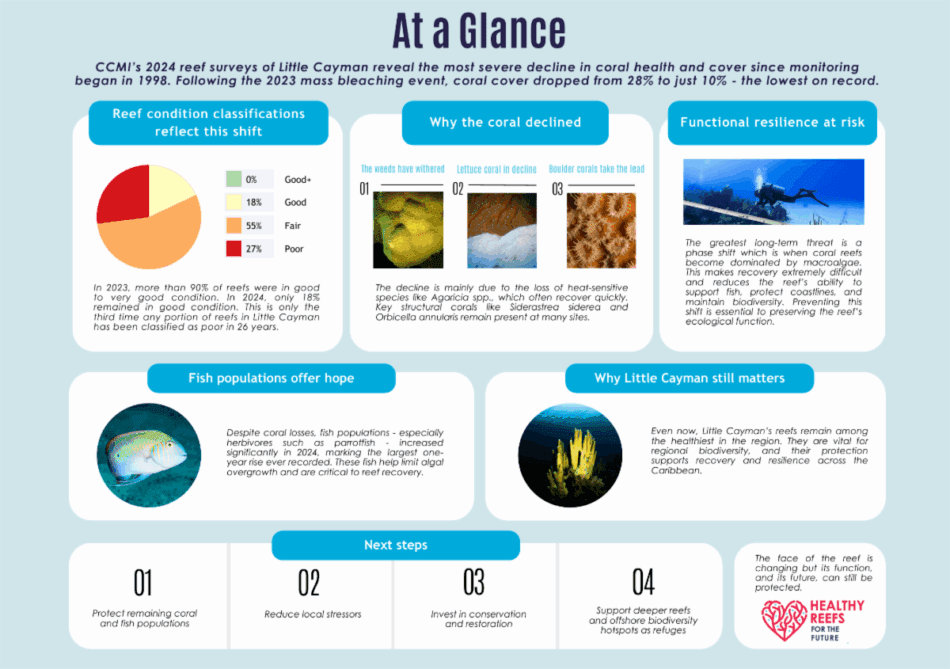
In honour of World Ocean Day 2025, we released our 2024 Little Cayman Healthy Reefs Report Card, which shows CCMI’s first annual reef monitoring results since the 2023 mass coral bleaching event. The results were sobering, showing the biggest decrease in coral cover since our monitoring efforts began in 1998, with coral cover decreasing from 28% in 2023 to 10% in 2024.
The same substantial decline was also observed in the condition of reefs, with only 18% remaining in good condition compared to 90% in 2023.
It’s clear that the 2023 coral bleaching event had significant consequences for reefs across the globe, but hope remains, especially for Little Cayman’s reefs. Little Cayman is still home to some of the healthiest reefs in the Caribbean, and on average, there is still double the amount of coral cover than reefs across the region. The high level of protection, remote nature of Little Cayman and the healthy fish populations (that only improved in 2024!) are positive signs that Little Cayman will recover well after this event and remain a beacon of hope throughout the Caribbean.
Our team is excited to begin the 2025 monitoring this summer and see how the reefs are beginning to recover. Look for more updates coming soon.
Read more about these results in our recent article.
With thanks to our 2025 Healthy Reefs sponsors, Wheaton Precious Metals International, Foster’s Supermarket, Cayman Islands Department of Tourism, Cayman Water, and Knighthead International.
Reef Lecture: Reefs of Wonder: The Fragile Reproduction of Coral in a Changing Ocean
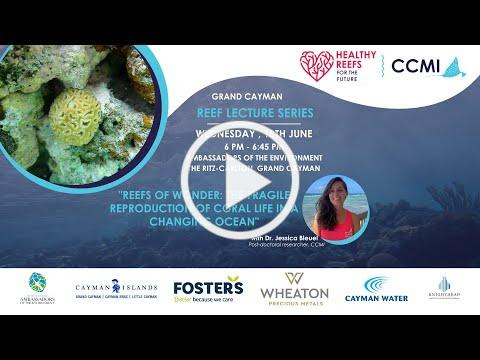
Visiting post-doctoral researcher Dr Jessica Bleuel gave a Reef Lecture in Grand Cayman on how rising ocean temperatures impact coral reproduction. She highlighted how these reproductive cycles, finely tuned over millennia, are now at risk due to the growing impacts of climate change, ocean acidification, and coastal development. We were excited to see 26 attendees at this event, eager to learn about this unique topic from Dr Jessica
Watch the recording of the Reef Lecture in this video or on our YouTube channel.
UPCOMING COURSES
Tropical Marine Ecology: From Fieldwork to Conservation
When: 12th – 21st December 2025
Where: Little Cayman Research Centre
Who: University students in marine science, biology, and environmental studies
Course fee: US $3,000 (excluding flights and insurance)
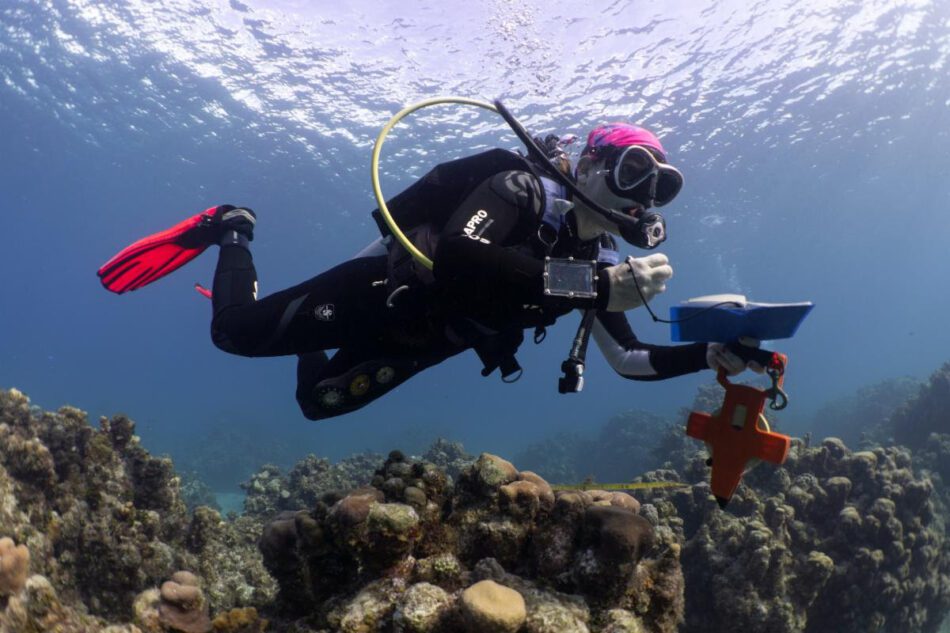
This 10-day intensive field course is designed for university students in marine science, biology, and environmental studies who are looking to develop practical research skills. Participants will learn fish and coral identification, conduct reef and mangrove ecosystem surveys, and explore coral restoration techniques including nursery propagation and transplantation methods. The course also includes discussions on marine conservation and resource management, connecting fieldwork to real-world conservation challenges.
Spaces are limited, register now!