
Extreme Weather Impacts Cost More Than $300 Billion in the U.S. This Year, Significantly Less Than the Catastrophic Losses in 2024
From AccuWeather Public Relations

> The costliest weather disasters in the U.S. happened during the first half of the year, a shift from the trend of most high-impact weather disasters occurring in the second half of the year
> Extreme rainfall events are happening more often in the contiguous U.S., increasing the risks to public safety, crop production and insurance affordability, according to an AccuWeather climate study
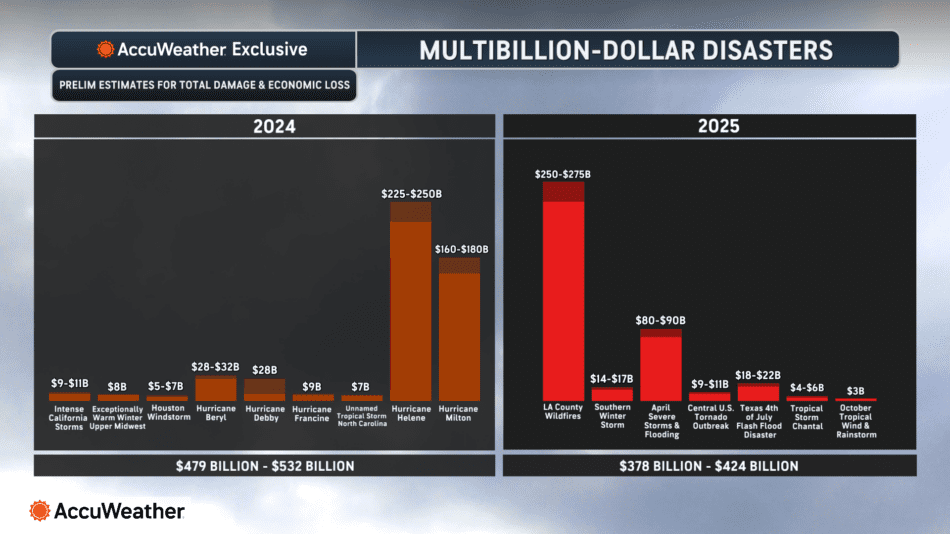
AccuWeather® Global Weather Center – Dec. 18, 2025 – Seven major weather disasters in the United States resulted in $378 billion to $424 billion in total damage and economic loss this year, according to preliminary estimates from AccuWeather® experts.
“The financial impact from extreme weather in America this year is staggering, even without a single hurricane landfall or a major fire impacting a highly populated area during the peak of the wildfire season,” AccuWeather®Chief Meteorologist Jonathan Porter said.
AccuWeather® experts estimate that catastrophic impacts from Hurricane Melissa resulted in $48 billion to $52 billion in total damage and economic loss in the western Caribbean.
2025 AccuWeather Preliminary Estimates for Total Damage and Economic Loss
- Catastrophic wildfires destroy neighborhoods near Los Angeles
$250B – $275B - Rare atmospheric river flooding and tornado outbreak in the central U.S.
$80B – $90B - Hurricane Melissa causes catastrophic damage in the Caribbean
$48B – $52B - Texas Hill Country flash flood disaster claims more than 100 lives
$18B – $22B - Historic winter storm brings snow to the Gulf Coast
$14B – $17B - More than 70 tornadoes strike the central U.S. during May outbreak
$9B – $11B - Tropical Storm Chantal triggers flash flooding in the Carolinas
$4B – $6B - October tropical wind and rainstorm causes widespread coastal flooding
$3B
“Millions of people across America are dealing with disaster fatigue. Families and businesses are struggling to rebuild and recover from flash floods, wildfires, tornadoes and other forms of extreme weather. The human impact is measured not just in the heartbreaking loss of life, but in higher insurance costs, rising rents and mortgages payments, lost jobs and long-term stress, physical and mental health challenges,” Porter said. “In recent years, our nation has faced destructive hurricane landfalls and major wildfires during the late summer and fall months. The lack of major weather disasters in the second half of this year has provided people and businesses with a much-needed break. Thousands of people and small businesses are still trying to recover from the catastrophic and costly impacts of extreme weather in 2024.”
This is the first year that the costliest weather disasters occurred during the first half of the year, since AccuWeather® experts started to issue preliminary estimates of total damage and economic loss for extreme weather events in 2017.
“The most destructive and costly weather disaster in the U.S. struck in the very first days of the year. Wind-driven infernos swept through neighborhoods near Los Angeles and Malibu, including some of the most expensive real estate in the country. Thousands of homes and businesses were destroyed. The January wildfires intensified the ongoing insurance affordability and availability crisis in California,” Porter explained. “A historic and disruptive winter storm brought snow and ice to the Southeast and Gulf Coast in January. A rare atmospheric river funneled months’ worth of rain into the central U.S. in a matter of days, triggering widespread flooding in April. Severe weather outbreaks produced dozens of destructive tornadoes in May, including one tornado that ripped through parts of the St. Louis metro area. Dozens of lives were tragically lost to extreme weather in the first half of this year. The recovery could take years, if not a decade or longer, in some of the hardest-hit communities.”
“It was quite unusual to see the costliest weather disasters happen during the first half of the year. They typically happen in the late summer and fall months, during the climatological peaks of hurricane and wildfire seasons,” Porter explained. “Every year and every season brings its own unique risks. We cannot rely on statistics and seasonal norms to gauge our vulnerability, especially as our climate continues to warm.”
AccuWeather® experts estimate that nine weather disasters in the U.S. in 2024 had a combined total damage and economic loss of $479 billion to $532 billion.
The Climate Connection to Extreme Weather
AccuWeather® climate experts say agriculture, supply chain logistics, as well as the tourism and travel sectors, have faced major financial setbacks and disruptions due to extreme weather over the past two years.
“A warmer atmosphere can hold more moisture, which in turn can unleash extreme rainfall rates that rivers, streams and aging drainage systems were never designed to handle. At the same time, rising ocean temperatures are extending the window for tropical development later into the fall and even into early winter. The combination of warmer air and warmer oceans is contributing to more frequent and more intense flash floods, more destructive hurricanes and longer wildfire seasons in parts of the country,” AccuWeather® Climate Expert and Senior Meteorologist Brett Anderson said.
An AccuWeather climate analysis released in November found that extreme rainfall events have increased dramatically in the contiguous U.S. over the past 30 years, even as average annual precipitation has decreased by 2.7% during the same period.
The findings highlight a growing paradox: More intense downpours and larger storms are driving an increased risk of destructive and deadly flash flooding, while the overall decline in yearly precipitation is worsening stress on agriculture and raising the long-term risks of drought and wildfires.
“More people, homes and businesses are in harm’s way as development pushes into flood-prone river valleys, fire-prone hillsides and low-lying coastal areas. The odds of high-impact weather disasters increase when you factor in a warmer climate and hotter oceans,” Anderson said.
According to global average temperature data, 2025 is currently on track to become the second hottest year on record, likely tying 2023 and pacing just behind 2024.
Research is also linking extreme weather events in America to more long-term health issues, leading to costly medical expenses for more people.
Extreme and Record-shattering Weather Events of 2025:
- Atlantic season ends with no US hurricane landfalls, but one record-shattering Caribbean storm
- Hurricane Melissa’s 252-mph wind gust sets new record
- The first EF5 tornado since 2013 has been confirmed in North Dakota
- World’s longest lightning flash from Texas to Missouri confirmed as new record
- Over 3,000 high temperature records set during heat wave
- This March was the windiest on record
- Global sea ice reaches new record low
- Florida beats Alaska seasonal snow after Gulf Coast snowstorm
About AccuWeather® Total Damage and Economic Loss Preliminary Estimates:
AccuWeather® incorporates independent methods to evaluate all direct and indirect impacts of the storm, includes both insured and uninsured losses and is based on a variety of sources, statistics and unique techniques AccuWeather® uses to estimate the damage. It includes damage to property, job and wage losses, crops, infrastructure, interruption of the supply chain, auxiliary business losses and flight delays. The estimate also accounts for the costs of evacuations, relocations, emergency management and the extraordinary government expenses for cleanup operations and the long-term effects on business logistics, transportation and tourism as well as the long-term and short-term health effects and the medical and other expenses of unreported deaths and injuries.
AccuWeather® is the trusted source for total damage and economic loss estimates for weather disasters in the United States. Our recognized experts incorporate independent methods to evaluate all direct and indirect impacts of extreme weather events. In 2017, AccuWeather® first issued a widely quoted preliminary estimate for total damage and economic loss during catastrophic flooding from Hurricane Harvey along the Gulf coast, which helped people in the impacted area, and across the country to better understand the magnitude of the disaster.
Additional AccuWeather® Resources:
Extreme weather events are happening more often, having a larger impact on the national economy