
CRFM participates in Blue Ventures’ Second Food Security Forum in Belize

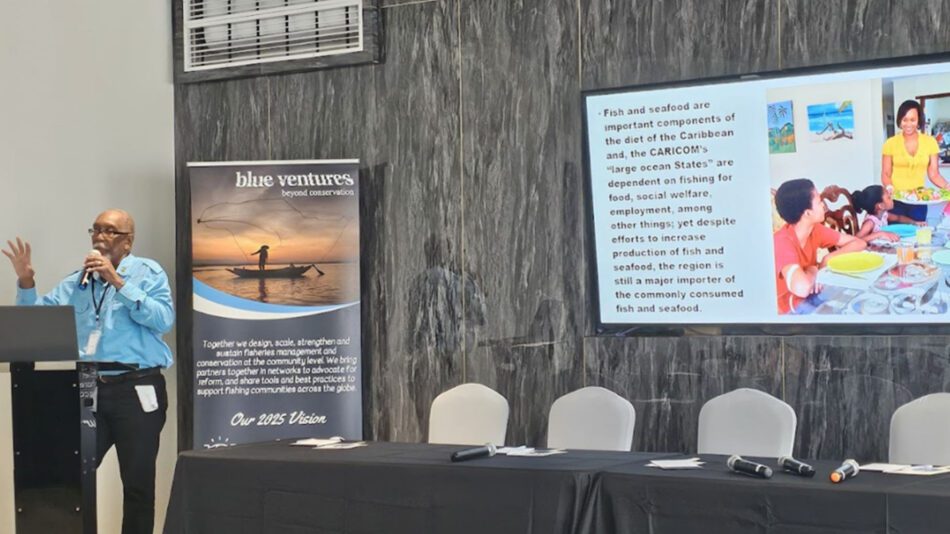
| Mr. Peter A. Murray, Advisor, Fisheries Management and Development, represented the Caribbean Regional Fisheries Mechanism (CRFM) Secretariat at the Second Annual Food Security Forum, hosted by Blue Ventures in Belize City on Friday, 28 November. Mrs. Breanna Mossiah-Conorquie, Blue Ventures Country Director, delivered the Opening Remarks. She stated that this forum was essentially being hosted by fishers. |
 |
| “Their input can be the foundation of efficient food systems. Local knowledge can guide action at the national level,” she added. She explained that Blue Ventures’ strategy is based on a bottom-up approach, with human rights principles being central. Murray said that at the Forum, Belizean fishers in the opening panel emphasised the importance of their involvement in the decision making process. He added that they are also concerned about legal restrictions that prevent training of younger persons (under 18 years) by not allowing hands-on, at sea, involvement. Views were also expressed that fishers are limited in resources to find new fishing grounds, given that (1) the traditional ones seem to be showing signs of depletion and (2) they do not want to encroach on protected areas. Forum attendees also discussed the importance of investigating how “deep sea” fishing can benefit fishers’ livelihoods, especially with increases in protected areas, as well as the need to sensitise markets with regard to “new” target or caught species. It was also noted that receiving feedback from the Belize Fisheries Department on stock status is imperative. |
 |
| Panel members from left to right: Mr. Carlos Arevalo of Chunox Fishermen Association; Mr. Mark Thompson of Wabafu Fishermen Association; Ms. Isela Martinez of Blue Water Fishermen Association; Mr. Marley Nunez of Yugadan Fisherfolk Association; and Mr. Victor Jacobs of Southern Grassroots Fishers Association. Moderator (standing) Jennifer Chapman, independent consultant and conservationist |
 |
| FAO representatives–Mr. Jeffy V. Gomez, FAO Climate Change Adaptation and Disaster Risk Management Project Specialist (left), and Mr. Armando Aban, FAO National Consultant for Belize–presenting on their support to fisheries and coastal zone management in Belize |
| The FAO representatives outlined the FAO’s work in Belize on agriculture, blue economic development and school feeding programmes. Among the work done by the FAO is a gender analysis of the fisheries sector and based on this, a gender strategy and action plan with an M&E strategy were also formulated. Other achievements include a vulnerability and livelihood assessment for 4 communities and the development of a National Adaptation Strategy for Fisheries and Coastal Zone. An FAO study has shown that 5.9% of Belize’s population suffers from severe food insecurity and 45% from moderate food insecurity. The FAO supports school feeding programmes, and 78 schools (serving 15,000 children) were benefiting. It was noted that no fish is included in the feeding programme, so there is an opportunity for fishers to contribute. |
 |
| Mr. Nestor Perez of National Fishermen Cooperative Society Limited spoke on “the business of seafood security” and expressed the hope that improvements will come soon! |
| Mr. Murray’s presentation focused on CARICOM Regional Food Security Policies, with an emphasis on the Protocol on Aquatic Foods as a Strategic Resource for Food and Nutrition Security under the Caribbean Community Common Fisheries Policy (CCCFP), which the CRFM Ministerial Council approved in 2023 as a part of the Policy. He underlined the importance of fish and seafood in the diet of the Caribbean people. He said that fish and seafood represent healthier options in terms of protein content and other health benefits and can contribute positively to a reduction in lifestyle diseases, such as hypertension and diabetes. Mr. Murray added that CARICOM’s “large ocean states” are dependent on fishing for food, social welfare, employment, among other things. Notwithstanding efforts to boost seafood production and access, he said, the region is still a major importer of the commonly consumed fish and seafood. Murray said that for shifts in consumption to occur, attention needs to be given to production, utilization, legal framework, and education to facilitate and support sustainability and proper management of the resources; support by governments for the strengthening of the fisheries sector; and public education with respect to the choice of fish and seafood that would provide optimum benefits and minimum disadvantage. The CARICOM Regional Food and Nutrition Security Policy, approved in 2010, addresses: FOOD AVAILABILITY: Promote the sustainable production of safe, affordable, nutritious, good quality Caribbean food commodities/ products; FOOD ACCESS: Ensure access of Caribbean households and individuals to sufficient, nutritious affordable food at all times; FOOD UTILIZATION/NUTRITIONAL ADEQUACY: Promote the commercialization and consumption of safe, affordable, nutritious, quality Caribbean food commodities/products; and FOOD STABILITY: Improve the food and nutrition security resilience of the region to natural and socio-economic shocks and climate change. |
| Meanwhile, the CRFM’s Protocol on Aquatic Foods as a Strategic Resource for Food and Nutrition Security under the Caribbean Community Common Fisheries Policy aims to support the sustainable use of fish and seafood as a strategic resource for food and nutrition security for the peoples of the Caribbean. Mr. Murray also noted that the CARICOM enabling frameworks established by the Caribbean Community Common Fisheries Policy and its Protocol on Securing Small-Scale Fisheries and the CARICOM Regional Food and Nutrition Security Policy provide a coherent and comprehensive framework for identifying, financing, implementing, and monitoring an integrated set of concrete actions. These policy instruments, he explained, guide the region’s collective efforts to achieve the objectives of food availability; food access; proper food utilisation for good health, nutrition and well-being; and stable and sustained food supply; as well as providing opportunities to reassess and refocus Member States’ policies, programmes and investments at the national and regional levels. |