
AI Makes Alibaba Great Again
By Michael Spencer and Tony Peng from AI Supremacy
You are reading AI Supremacy, where we explore AI at the intersection of business, society, culture and technology.
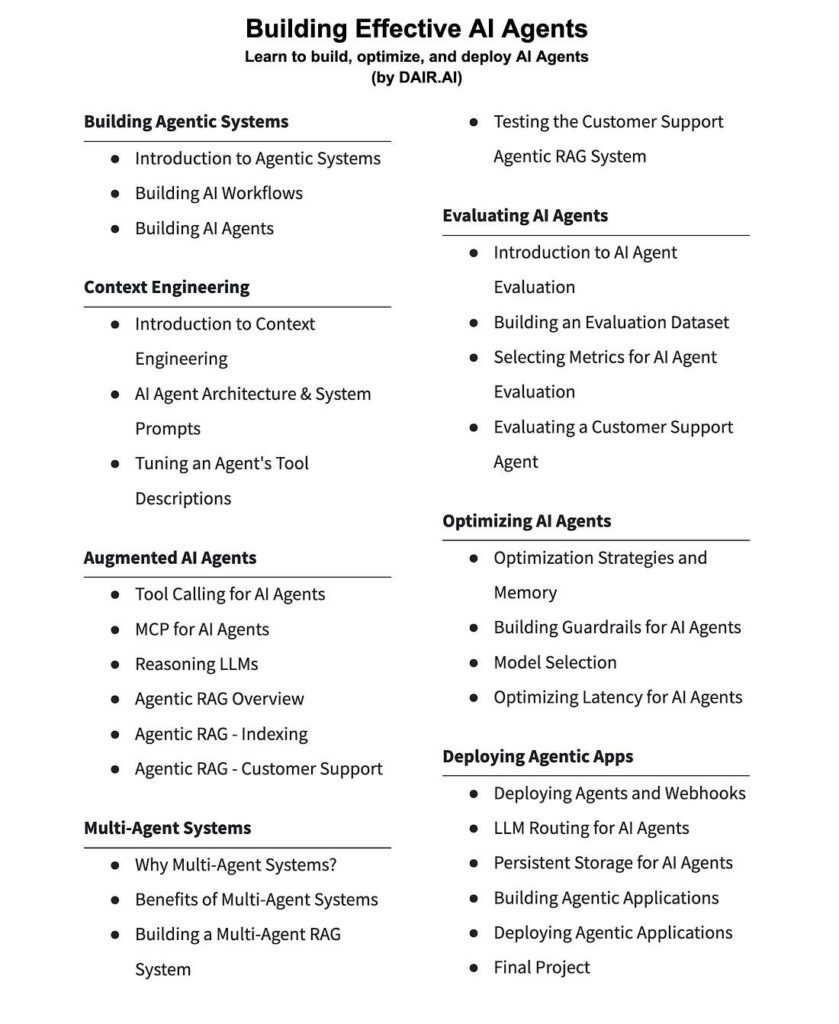
Elvis Saravia has built a course on Thinkific about Building Effective AI Agents. He’s put together the ultimate curriculum to learn how to build AI agents with n8n, it’s paid but worth a look if this is one of your passions.
This is not a sponsor or an endorsements and I don’t get any commision, just an FYI.
AI Makes Alibaba Great Again
China’s approach to open-source AI, AI Infrastructure and internal semiconductor options gains momentum in 2025.
| MICHAEL SPENCER AND TONY PENG OCT 6∙PREVIEW |
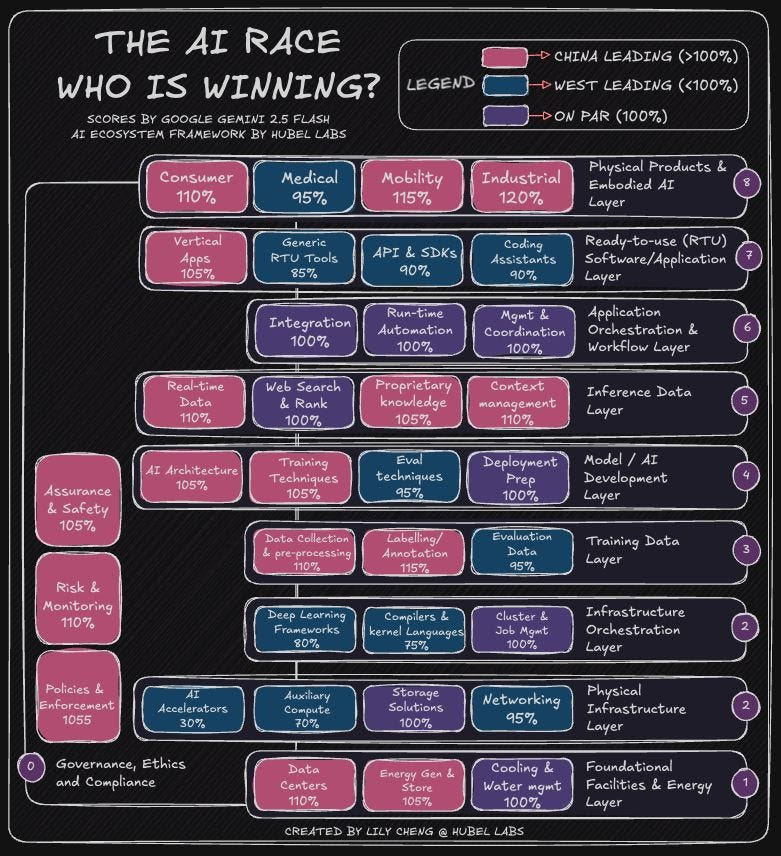
Image by Lily Cheng (Singapore), consulting Google Gemini.
Some stories in AI are too big to go untold, the white elephant in the room people talk about only when the music starts to play (e.g. the return of Jack Ma to Alibaba campuses). The rise of Alibaba Qwen is one of those stories in technology of the 2020s
The competition in AI between the United States and China is going to lead to a lot of progress for civilization. The capital intensive commercial approach of the West and an engineering efficiency approach by scrappy labs in China winning on cost-efficacy and price really are complementary. China now in 2025 leads in open-weight LLM innovation by a fairly sizeable margin.
Since the DeepSeek moment in January 2025, Qwen’s team (Alibaba Cloud) have iterated an incredible array of open-weight models culminating recently in Qwen3-Next. Alibaba recently announced a partnership with Nvidia, and a ramping up of its Capex in AI Infrastructure and global datacenter projects beyond expectations surprising many.
Alibaba has been trending of late, even with the ADR stock up 112% year to date (YTD) $BABA . Shareholders are rewarding Alibaba’s aggressive plans to expand datacenters in new locations: when at the company’s Apsara Conference 2025 last week, Alibaba Cloud announced plans to launch its first data centers in Brazil, France, and the Netherlands, with additional data centers to be added in Mexico, Japan, South Korea, Malaysia, and Dubai in the coming year. When I refer to AI Supremacy, I’m primarily concerned with this AI arms race between the U.S. and China.
I asked Tony Peng for a deep dive into Alibaba’s new life in AI and what it means for the ecosystem as a whole. Tony writes Recode China AI, one of my favorite Newsletters to track China’s AI breakthroughs.
Recode China AI
China AI Spotlight: Your weekly guide to China’s AI breakthroughs, trends, and stories.
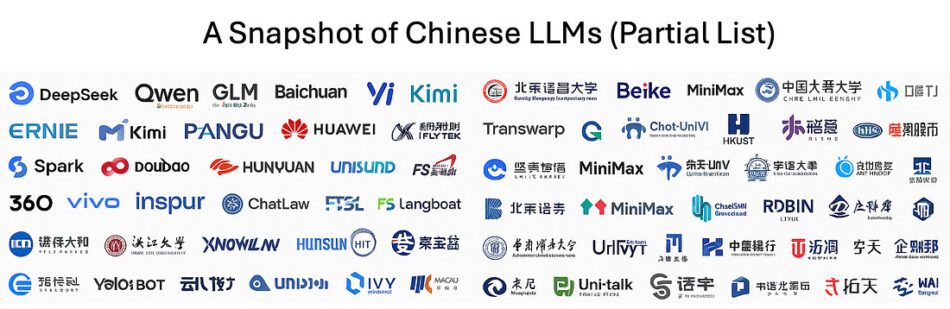
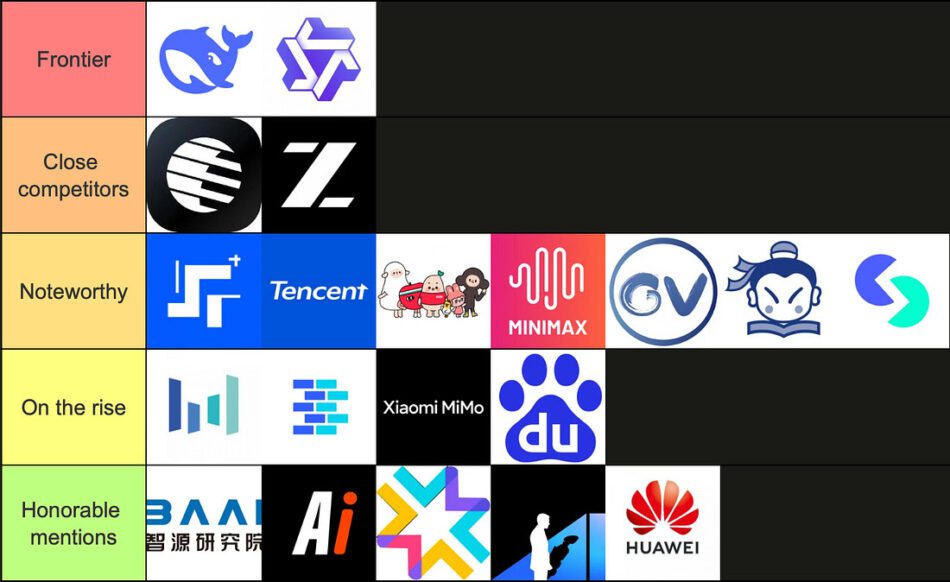
The recent DeepSeek series by Denis Kalinin and works by afra (AZW), Poe Zhao (Hello China Tech), newly arrived Matt Sheehan and increasingly more good outlets covering China Tech (e.g. Rui Ma), comes with a lot more attention from Beijing on this platform as my Google Analytics can attest to. The way we need to think about leading U.S. and China AI labs needs to be updated now on a monthly basis (no longer Quarterly) as we await DeepSeek-R2 since DeepSeek-V3.2-Exp doesn’t seem to be much besides a DeepSeek Sparse Attention (DSA) with a cost cut. China’s LLM ecosystem has never looked so impressive as pesky open-source models turn to AI agentic products:
Denis Kalinin.
Nathan Lambert
What I’m reading related to today’s topic:
- Who Will Fill Nvidia’s AI Chip Void in China?
- AI Prophecy from Hangzhou
- america against china against america
- China’s Big AI Diffusion Plan is Here. Will it Work?
- America Cannot Lose the Robotics Race
- China’s AI Playbook: How State Power and Open Source Are Forging a New Order in Tech
Why is Alibaba special and its stock rising so fast in 2025?
Alibaba has been aggressively advancing its AI strategy, positioning itself as a key player in both open-source models and infrastructure amid intensifying global competition. Alibaba is on track to be the “Google of AI” of China in Generative AI taking a full-stack, open-source, Cloud and AI Infrastructure approach.

- Topology of “China AI”
- Alibaba Gets AGI-pilled on Jordan Schneider’s China Talk.
Alibaba’s Cloud and Datacenter Announcements are Key in 2025
- What is Qwen?
“Qwen, also known as Tongyi Qianwen (通义千问), is a family of large language models (LLMs) developed by the Chinese technology company Alibaba Cloud.”

Alibaba is suddenly trading in the AI Boom
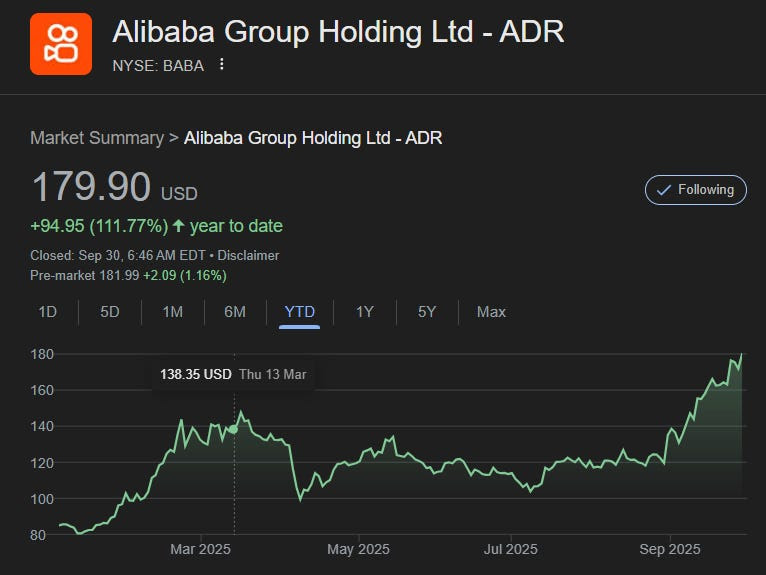
I have huge respect for Tony Peng (formerly at Baidu) as an AI journalist. I’m also fairly bullish on Alibaba, and have been for a number of years. As the United States abandoned open-source in Meta’s failure with Llama, only Thinking Machines by Mira Murati on the horizon looks legit in that area. This has left open-weight LLM leadership open for China who are likely to reach more of the developing world with their models now.
“AI is revolutionizing not only technology, but also the very foundation of how enterprises deliver business value and drive growth. Our strategic expansion of global infrastructure is designed to cater for the accelerating demand from forward-thinking customers.” – Dr. Feifei Li, president of international business and SVP of Alibaba Cloud Intelligence Group
Alibaba is expanding datacenters globally in 2025 like Microsoft did in 2024, and it’s sort of a big deal for the future of the geopolitics around AI.
Follow Qwen on X/Twitter
The Geopolitics of Datacenters
Alibaba’s first entry with datacenters into new regions is a sign of things to come: Datacenters in the Netherlands, France, and Brazil are now on the books. Their expansion into Europe and South America is symbolic and mirrors a China surge on the regional retreat of the U.S. to their own shores.

In a world where Alibaba is surprisingly executing on LLMs at Google’s level in 2025, what does that mean for the future of AI globally? Qwen has pushed the DeepSeek moment into overdrive prophesised by employees at Google many moons ago. This is not an untold story but a narrative Washington doesn’t understand, and one that Silicon Valley BigTech is already losing